Thursday, December 30, 2021

The Infrastructure Bill and the SFMTA

The Infrastructure Bill and the SFMTA
By

What the infrastructure bill means for the SFMTA

On December 20, Speaker of the House Nancy Pelosi joined Mayor London Breed and US Representative Mark DeSaulnier to promote the Infrastructure Investment and Jobs Act that was signed into law in November. They held an event at the corner of Second and Howard Streets to explain how the bill will benefit California and show the type of street improvements it can pay for to improve pedestrian safety. These include things like wider sidewalks, protected bike lanes, transit boarding islands and ADA-compliant curb ramps. It’s through these types of improvements that San Francisco will be able to reach its goal of eliminating traffic fatalities.

The Metropolitan Transportation Commission (MTC), which coordinates Bay Area transportation financing, estimates that the infrastructure bill will provide about $4.5 billion in funding to the region over the next five years via formula funds that the MTC allocates. This is $1.1 billion more than was available than during the last five-year funding cycle.

The MTC will decide how to divide up the infrastructure bill formula funds among Bay Area transit agencies. It can go toward State of Good Repair needs such as fleet replacement and rehabilitating cable cars and historic streetcars. It can also be used to fund “guideway” needs like replacing rails and overhead cables. If the MTC follows its historic pattern of formula funding distribution, the SFMTA can expect 27% more in additional funds for Fleet Replacement and 49% more in additional funds for Fixed Guideways than during the last funding period.

The infrastructure bill also includes about $140 billion in competitive grant funding that will be administered throughout the country by the U.S. Department of Transportation. The SFMTA is in a good position to compete for these funds, which are available for capital investments; low-emission and no-emission vehicles and infrastructure; and safe streets projects like the one that was highlighted at Speaker Pelosi’s Dec. 20 event. But, since these funds are available through a competitive process, nothing is guaranteed. For example, the safe streets funding is the first nationally competitive program of its size, so we anticipate that competition for it will be strong.

As great as it is that the SFMTA and other transit agencies will receive extra funding through the infrastructure bill, it’s not enough money to eliminate all the agency’s financial needs. The infrastructure bill doesn’t provide any funding at all for operating expenses, which increase every year because the cost of parts, labor, fuel and living in the Bay Area just keep going up. It also doesn’t make a sizeable dent in our State of Good Repair needs and our funding needs for major capital projects.

Additionally, almost every source of federal funding requires a match of 20% from local sources, and in many cases, it requires more than that. The federal government wants to see that local policymakers prioritize the transportation needs the feds are being asked to support. This is where the Muni Reliability and Street Safety General Obligation Bond proposed for the ballot in June 2022 comes in. It could be a source of local matching funds for some of the federal funding the SFMTA is going to apply for. GO Bond funding could also support projects that the infrastructure bill is less likely to fully fund, such as facility replacement.

While funding facilities may not be as exciting as funding zero-emissions buses, the two are inextricably linked. Several SFMTA facilities will need to be fully replaced to be able to store and charge the new buses once we transition completely to battery-electric buses. Upgrading our facilities is also essential to providing a safe and healthy working environment to our staff. Some of our facilities are so old that they don’t have heat and aren’t ready for a major earthquake. Providing our staff with safe working conditions is crucial for the functioning of transportation in San Francisco.


Published December 30, 2021 at 10:30AM
https://ift.tt/3mHFUM0

Labels: ,

Monday, December 27, 2021

Free Muni for New Year’s Eve

Free Muni for New Year’s Eve
By Stephen Chun

2021 marks the 22nd consecutive year that we will offer free rides on New Year’s Eve. Starting at 8 p.m. on Friday, December 31 and going through 5 a.m. on Saturday, January 1, all trips on Muni will be free. This program supports San Francisco’s Vision Zero goals to eliminate all traffic fatalities and serious injuries as well as promotes safe and responsible transit during the New Year’s festivities.  

Please note that face masks are still required by federal law while riding Muni, in Muni stations, on paratransit and in taxis. Violations can result in denial of boarding or removal from Muni and may carry federal penalties. 

Ride Muni Free New Year’s Eve includes all Muni lines and routes. Clipper Card customers should NOT tap their cards to make sure they don’t get charged a fare. Muni Mobile passes will not be necessary. Metro fare gates will be open that night. 

New Year’s Eve Muni Service:  

  • Complimentary Muni service from 8 p.m. Friday, December 31 to 5 a.m. Saturday, January 1. 

  • Please do not tag your Clipper® card. If you tag it, you will be charged. 

  • Please do not activate a Muni Mobile ticket. Metro fare gates will be open. 

  • Extra Muni Metro service: 

  • Between West Portal Station and 4th & King from 9 p.m. until 1:45 a.m. 

  • Between West Portal and Embarcadero stations from 1:45 to 2:15 a.m. 

  • Extra service on the OWL Network, from 9 p.m. to 5 a.m.: 

  • Bus Substitutions 

  • Service on the F Market & Wharves historic streetcar line is provided by buses all day 

At midnight on New Year’s Eve, a city-sponsored fireworks show from a barge off The Embarcadero, south of the Ferry Building, will take place. Motorists should anticipate delays in the area from approximately 11 p.m. to 1 a.m. Beginning around 10 p.m., Muni will reroute around the Ferry Building area due to the anticipated crowd. For reroutes, please visit New Year's Eve Free Muni and Extra Service. Service will return to normal once the streets are clear.  

BART, with full fare pricing still in effect, will run standard Friday service, but with an extended closing time to allow people to enjoy fireworks in San Francisco or other festivities ringing in the New Year. For those celebrating in downtown San Francisco, the last East Bay bound train running through Downtown San Francisco will be at around 1:30am and the last Southbound train heading toward Millbrae will run through Downtown San Francisco at 2:10am. See the full details about New Year's Eve service.   

Caltrain service will be free after 8 p.m. on New Year’s Eve until the last special post-event train departs San Francisco. Trains will run past midnight until 1:30 am or until full.  

SamTrans will offer free rides on all buses beginning at 8 p.m. on December 31 until 5 a.m. on January 1.  


Published December 27, 2021 at 11:20AM
https://ift.tt/3pv8j9W

Labels: ,

Thursday, December 23, 2021

Central Subway Revenue Service Update

Central Subway Revenue Service Update
By Enrique Aguilar

Central Subway Finishes Year on a High Note

As we say goodbye to 2021 and bring in the new year, construction crews for the Central Subway remain laser-focused on the finish line and are working towards completing items in our substantial punch list. It includes testing and certifying elevators and escalators, installing all ticket vending machines and completing small tasks that need to be addressed before the start of service, anticipated for October 2022.

Early next year, construction work will continue on the surface near 4th and King streets to install overhead wire and support systems connecting the Central Subway to the existing Metro system. Train and traffic signaling work and installation of new street lighting between Bryant and Townsend will also resume on 4th Street.

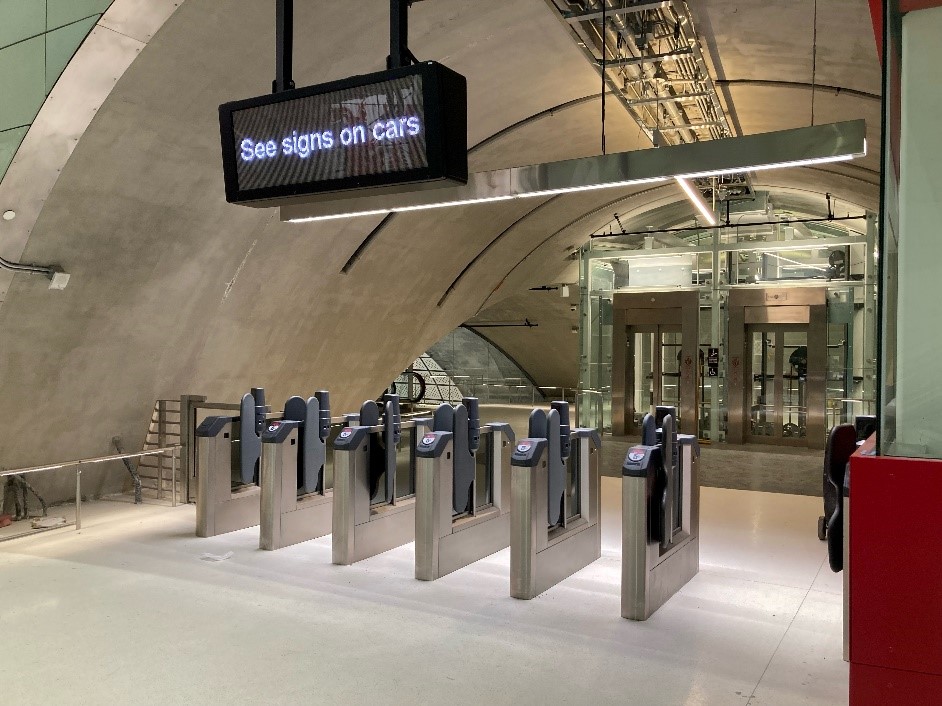
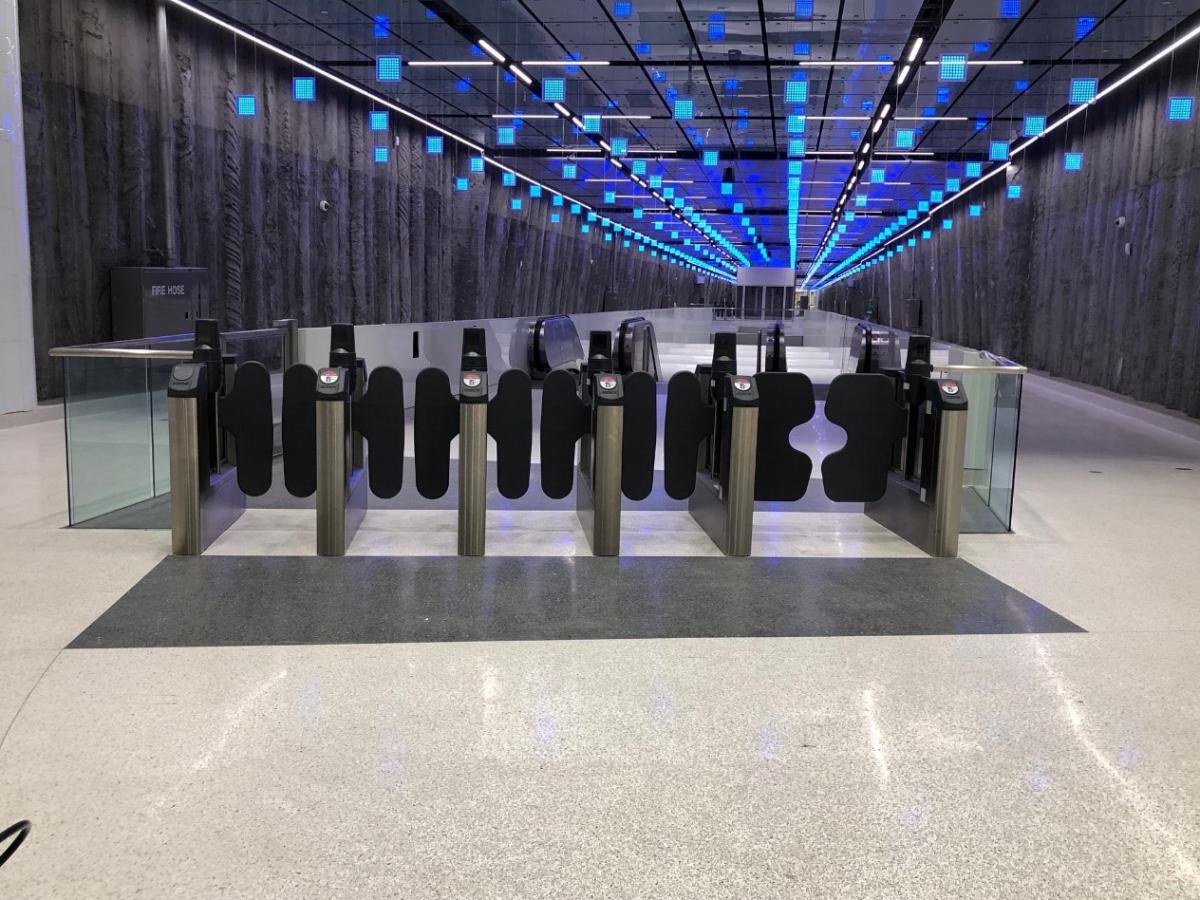
Now that station elevators and escalators are fully functional and tested, equipment must be certified to meet local and federal safety requirements. Fare gates have been installed at all stations and we expect to complete the installation and testing of ticket vending machines In January. With train testing in full gear since August, we anticipate concluding operational testing in the summer of 2022.

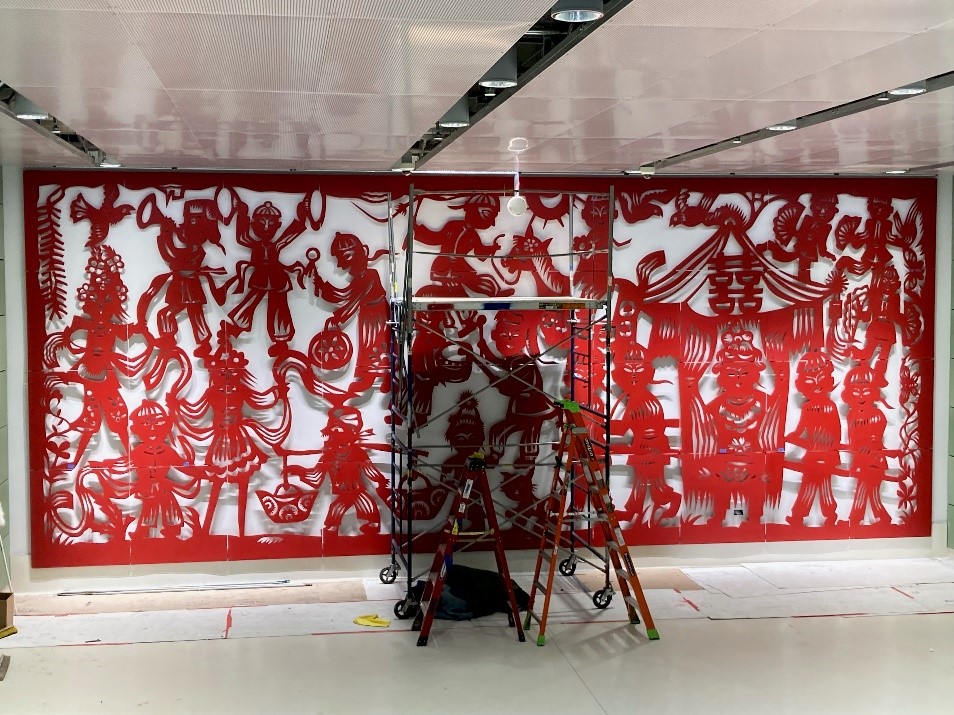
Artwork by Yumei Hou is being installed in Chinatown/Rose Pak Station. The artwork consists of two large-scale metal installations based on Yang Ge (Sprout Dance), a folk dance originating in Northeastern provinces in China. Artwork installation in the mezzanine landing is complete and we hope to have artwork in the ticketing hall in full display by the end of the month.

We will continue to bring you updates and share the good news as we prepare for Central Subway’s grand opening and celebrate this historic moment for San Francisco. For project updates, please visit https://www.sfmta.com/projects/central-subway-project.

Recently installed fare gates at Chinatown/Rose Pak station

Recently installed fare gates at Chinatown/Rose Pak station

Artwork by Yumei Hou at Chinatown/Rose Pak Station

Artwork by Yumei Hou at Chinatown/Rose Pak Station

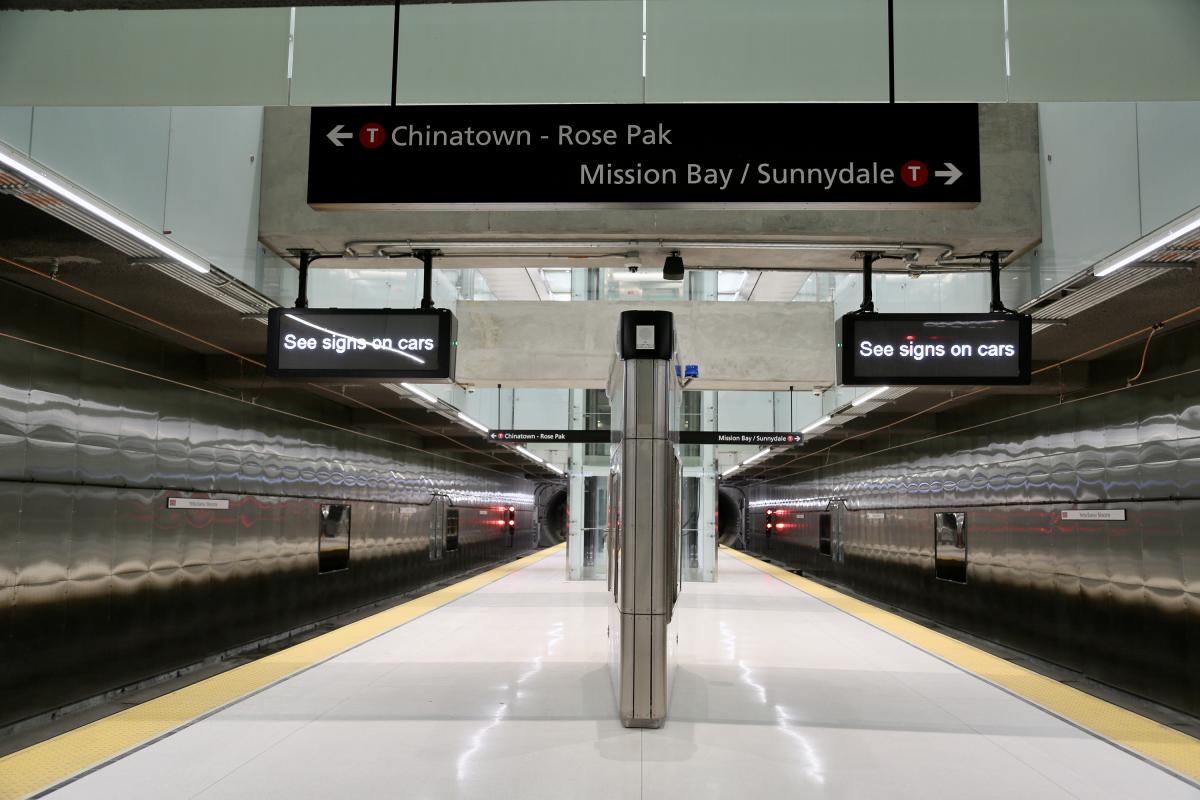
Platform at Yerba Buena Moscone Station

Platform at Yerba Buena Moscone station


Published December 23, 2021 at 12:26PM
https://ift.tt/3qoHNOG

Labels: ,

Friday, December 10, 2021

Approved: 2022 Muni Service Plan

Approved: 2022 Muni Service Plan
By Mariana Maguire

The Muni Service Network proposal for early 2022, and the next steps for the J Church and 48 Quintara, were unanimously approved by the SFMTA Board of Directors on Tuesday December 7, 2021. On Tuesday December 21, SFMTA staff will return to the Board of Directors to outline a phased service change implementation schedule currently slated to begin in February 2022.

SFMTA will restore five routes in full – 6 Haight/Parnassus, 8AX Bayshore A Express, 8BX Bayshore B Express, 28R 19th Avenue and the 43 Masonic – and four routes with some changes – the 2 Clement, 10 Townsend, 21 Hayes and 31 Balboa. Two routes will remain temporarily suspended – the 47 Van Ness and the 3 Jackson. These routes largely overlap other routes that are or will be in service. Instead, improvements that were approved December 7 will help to reduce crowding and wait times on high ridership Muni lines in the same neighborhoods.

The 2022 Muni Service Plan was developed in part through an extensive outreach process. Meetings, open houses, office hours, community pop up events, emails and phone calls with community members helped identify the need to prioritize connections to food hubs and groceries, hospitals and services, and essential jobs for people with disabilities, seniors and lower income communities.

The 8AX Bayshore A Express and 8BX Bayshore B Express were not initially slated for restoration because the 8 Bayshore was already in service. But staff added the 8AX/BX to replace the 8 Bayshore during peak periods after engagement from communities in Visitacion Valley and Potrero neighborhoods. The 8 Bayshore will run less frequently along the Geneva and San Bruno corridors, but Visitacion Valley and Potrero communities will have much needed express service downtown, which will also help reducing crowding on the 8 Bayshore.

Throughout the COVID-19 emergency and recovery, the SFMTA prioritized restoring service to these, and other neighborhoods identified in the Muni Service Equity Plan.

Additional route changes will be implemented as recommended on routes like the 5 Fulton, 12 Folsom/Pacific, 23 Monterey, 57 Parkmerced and others. Many of these changes will increase capacity, reduce wait times and crowding, restore service and prior connections and provide new connections.

Next Steps for the J Church

The J Church will go back into the subway, with some caveats to preserve subway efficiency and avoid the logjams that notoriously plagued the subway pre-pandemic.

J Church frequency will be reduced to every 15 minutes and the Board asked SFMTA to monitor subway capacity as usage increases to reevaluate J Church Metro tunnel service if a threshold of delays is reached.

Accessibility upgrades at the intersection of Market and Church streets will also move forward and staff will study the possible use of historic street cars to provide one-seat service on the J Church to Embarcadero using existing surface tracks as an alternative to running the J Church in the subway tunnel.

Next Steps for the 48 Quintara

Near-term, the 48 Quintara will stay on its current route via Clipper Street. However, SFMTA will move forward with construction necessary to accommodate buses on Douglas Street and then reroute the 48 Quintara to Douglas in the outbound direction (the inbound direction will stay on Clipper Street).

For details of the approved 2022 Muni Service Network proposal, please visit the 2022 Muni Service Network webpage.


Published December 10, 2021 at 01:08PM
https://ift.tt/3dFC9lr

Labels: ,

Friday, December 3, 2021

Fulton Street Sees Transit and Safety Improvements

Fulton Street Sees Transit and Safety Improvements
By Shalon Rogers

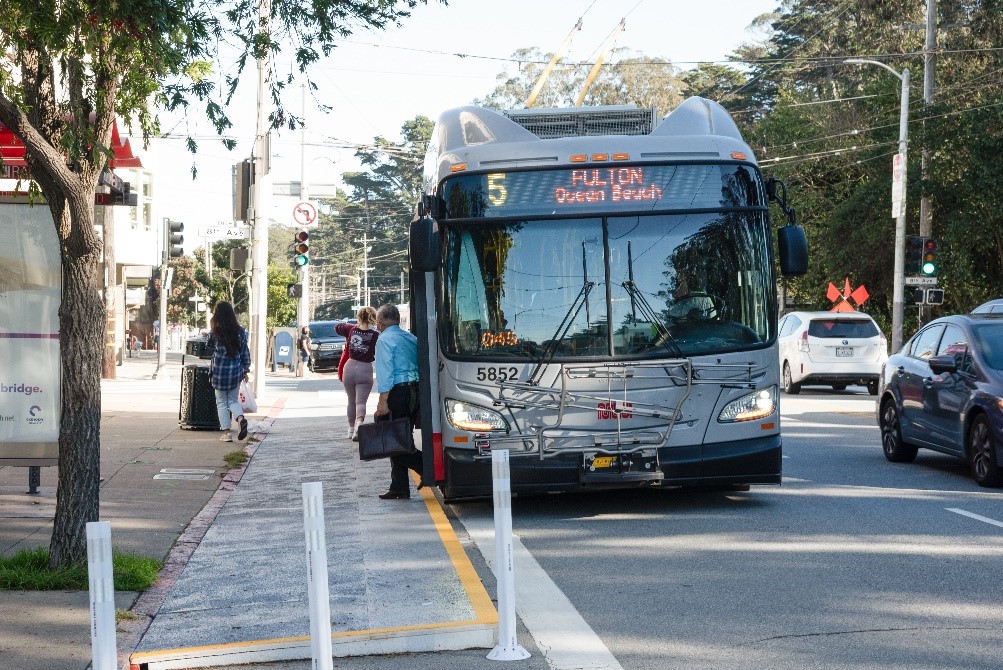
Photo of a 5 Fulton bus boarding passengers at a temporary transit bulb at 8th Avenue and Fulton, A temporary transit bulb was recently installed at 8th Avenue and Fulton, reducing travel time for the 5 Fulton and 5R Fulton Rapid and making boarding safer.
For those who ride the 5 Fulton or 5R Fulton Rapid in the Richmond District, you may have recently noticed something new about the bus stops on Fulton Street at 6th and 8th avenues. And perhaps you noticed that your bus ride seemed to go slightly faster or with less disruption.

Two new temporary transit bulbs installed at 6th Avenue eastbound and 8th Avenue westbound bring safety and transit benefits to Fulton Street in advance of the planned construction of permanent bulbs and are part of the Fulton Street Safety and Transit Project.

Six permanent transit bulbs between Arguello and 10th Avenue are ultimately planned, which will save time and improve reliability for riders on the 5 Fulton and 5R Fulton Rapid by reducing the time it takes for buses to pull in and out of traffic. The planned bulbs are all located at major entrances to Golden Gate Park, as well as on a stretch of Fulton Street that is part of San Francisco’s High Injury Network, the 13% of city streets that account for 75% of severe and fatal injuries. Both Muni riders and people who walk will benefit as the bulbs will expand the waiting area for riders, improve access for people with mobility needs and improve visibility for people walking.

With the installation of these temporary bulbs, we will have completed Muni Forward transit reliability upgrades along the entire route of the 5 Fulton and 5R Fulton Rapid – the first Muni lines to achieve this distinction. The bulbs add to over a decade of improvements to these lines, including:

  • Installed bus bulbs, traffic signals that stay green longer for buses, and other Muni Forward reliability upgrades on McAllister and outer Fulton (2017-2018)
  • Introduced 60’ buses on the 5 Fulton and 5R Fulton Rapid to reduce crowding that will be returning to service soon (2016-2017)
  • Upgraded and expanded transit lanes on Market, Fremont and Beale streets (2014-2021)
  • Launched the 5R Fulton Rapid, reducing travel times from the Outer Richmond by up to seven minutes (2013)
  • Made McAllister a two-way street, saving three minutes per trip (2011)
  • Extended evening service to Transbay Terminal (2009)

Additional safety improvements that have recently been completed on Fulton Street include daylighting (removing parking) at 34 intersections between Stanyan and La Playa streets and the installation of 13 painted safety zones. These enhancements improve visibility for drivers and make it safer for people walking. Soon we expect to install speed radar signs between 38th and 39th avenues and 40th and 41st avenues which will help reduce speeding and improve safety.

The project recently received additional funding with the help of Assemblymember Phil Ting, who secured $1.6 million from the state budget to be used on improvements along Fulton Street. Combined with a Caltrans Low Carbon Transit Operations Program allocation and Proposition K sales tax funds from the San Francisco County Transportation Authority, this funding will allow for improvements that will benefit tens of thousands of Muni riders and make Fulton Street a safer place for people walking.  


Published December 03, 2021 at 10:43AM
https://ift.tt/3xOyLy1

Labels: ,

Wednesday, November 24, 2021

From Elkton to Green, the Evolution of Muni’s Oldest Rail Yard

From Elkton to Green, the Evolution of Muni’s Oldest Rail Yard
By Jeremy Menzies

In part two of our two-part series on one of the city’s oldest transit properties, we bring you the history of Muni’s Green Division. Green Division, also known as Muni Metro Center, has served as the primary maintenance and repair facility for our rail fleet for over 40 years.

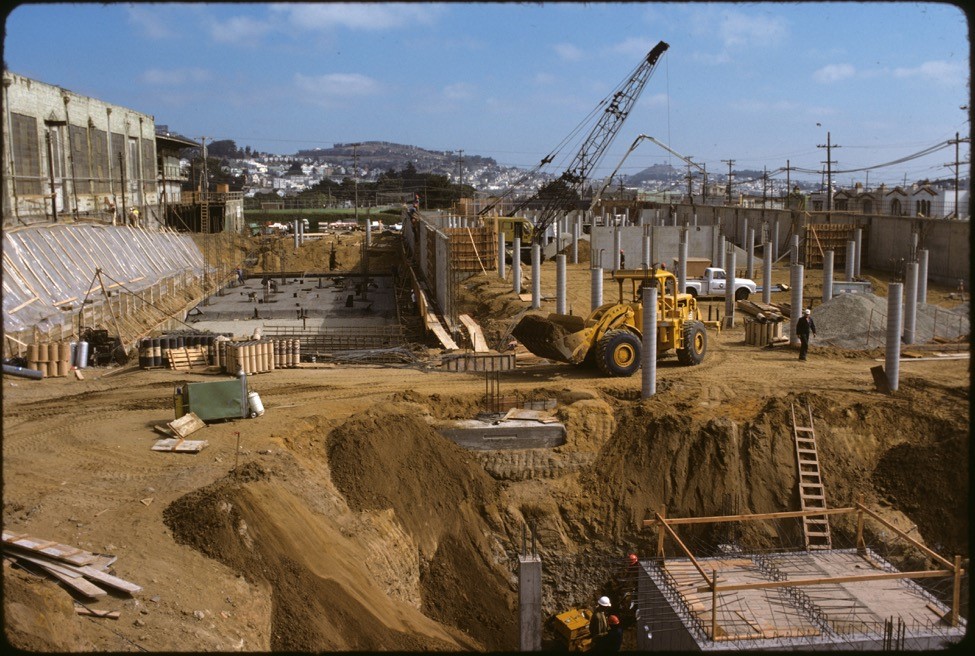
Construction began on Green Division in 1975. This new rail facility would replace Elkton Shops, which was built in 1907. The new shops were built in two phases, first the shop building then the rail yard.

This 1976 photo shows major excavation and concrete work underway for the main shops building of Green Division.  At far left is Elkton Shops built in 1907 by the United Railroads Company.This 1976 photo shows major excavation and concrete work underway for the main shops building of Green Division.  At far left is Elkton Shops built in 1907 by the United Railroads Company.
In phase one of the project, crews demolished the bus yard occupying the eastern half of the property and built a massive new building that would house repair and maintenance shops for a new fleet of Muni rail vehicles. This phase took about two years to complete.

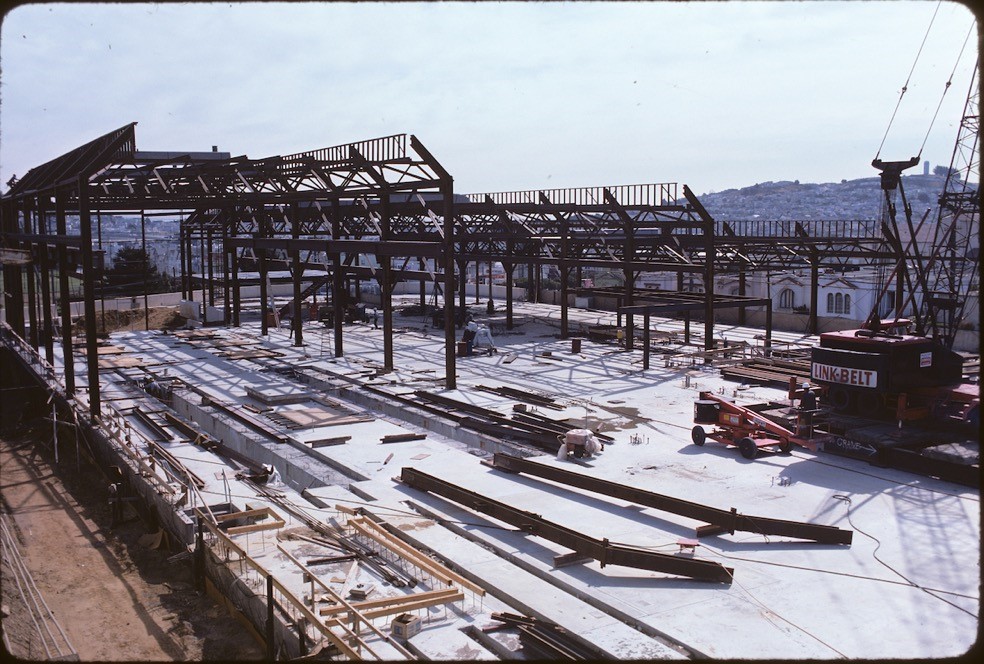
Construction progress on Muni Metro Center in November 1975 shows the main structure of the building taking shape.

Construction progress on Muni Metro Center in November 1975 shows the main structure of the building taking shape.

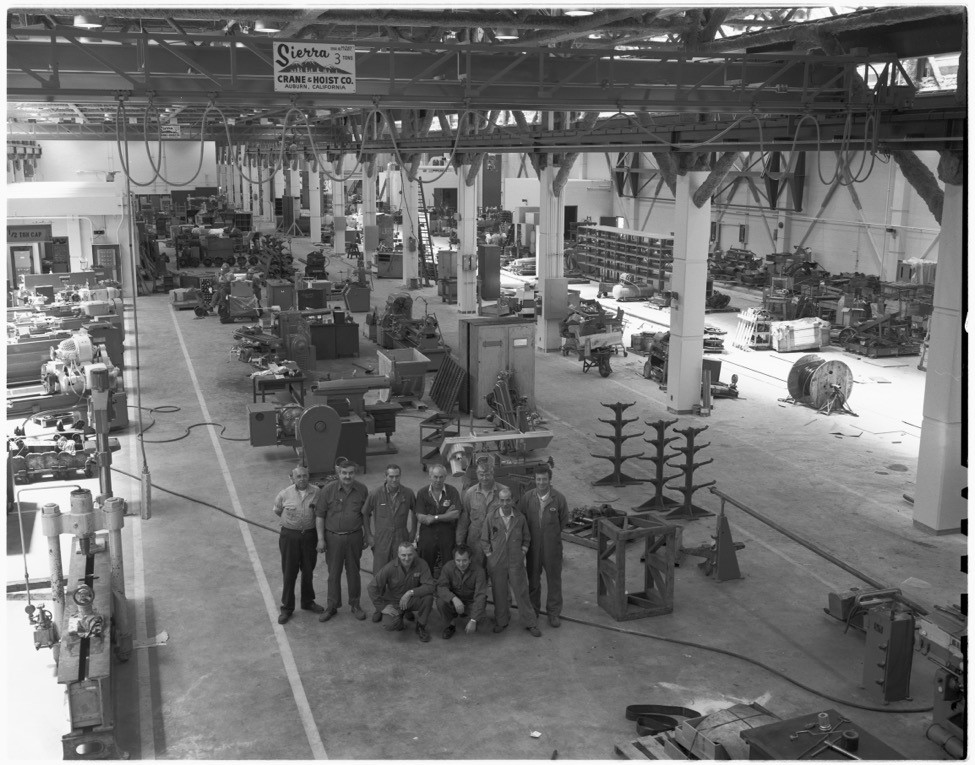
By May 27, 1977, the new shop building was completed and employees finished their last day of work in the 70-year-old Elkton Shops. Just a few days later, they moved into a brand-new building and demolition began on Elkton to make way for construction of a large rail yard in phase two of the project.

This staff group photo was taken on opening day of Muni Metro Center on June 1, 1977.

This staff group photo was taken on opening day of Muni Metro Center on June 1, 1977.

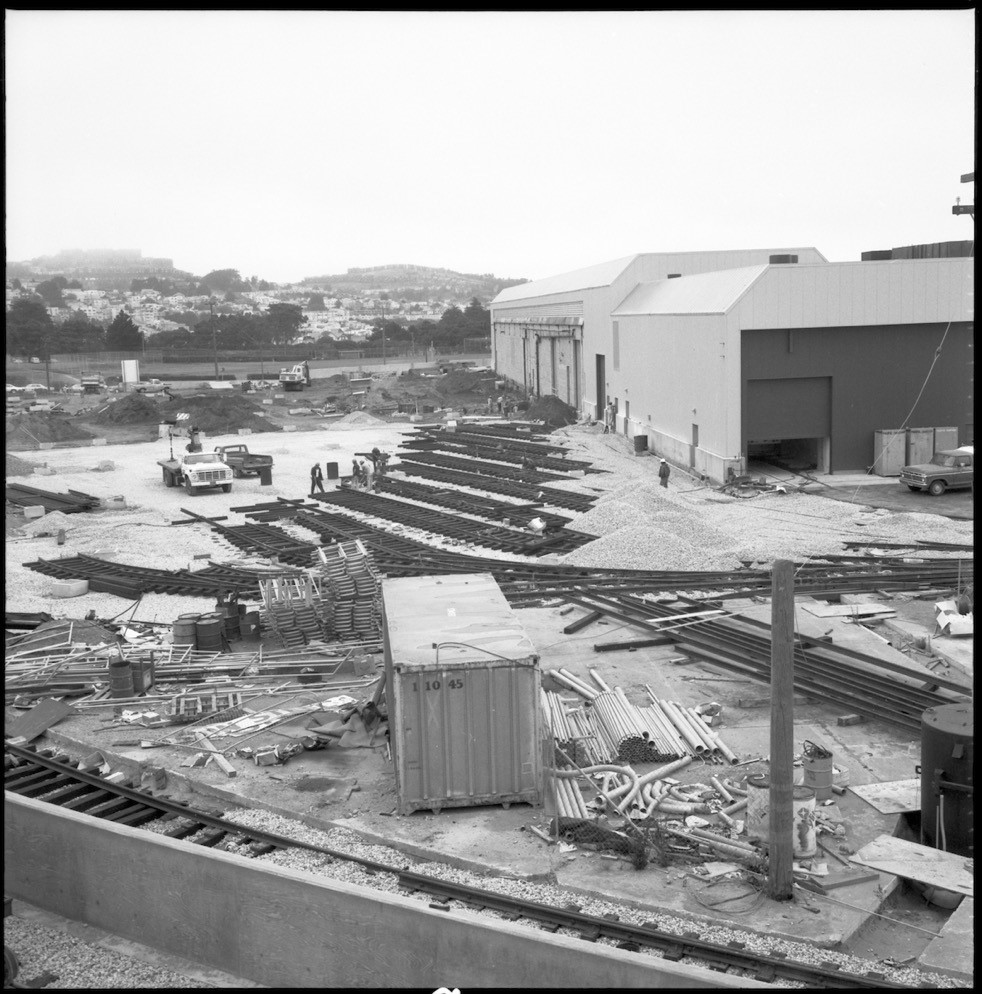
Work on the rail yard progressed quickly as Muni was anticipating the arrival of the first light rail vehicles or LRVs, a modernized version of the electric streetcars of the past. The new LRVs were designed and built by the Boeing Vertol company in a joint venture between Muni and Boston’s MBTA. The new vehicles would run in the Muni Metro, which combined Muni’s surviving streetcar lines with a subway underneath Market Street to create a more integrated rail system.

Aerial photo of construction on the rail yard where Elkton Shops once stood from August 1977

Work progresses on the rail yard where Elkton Shops once stood in this August 1977 photo.

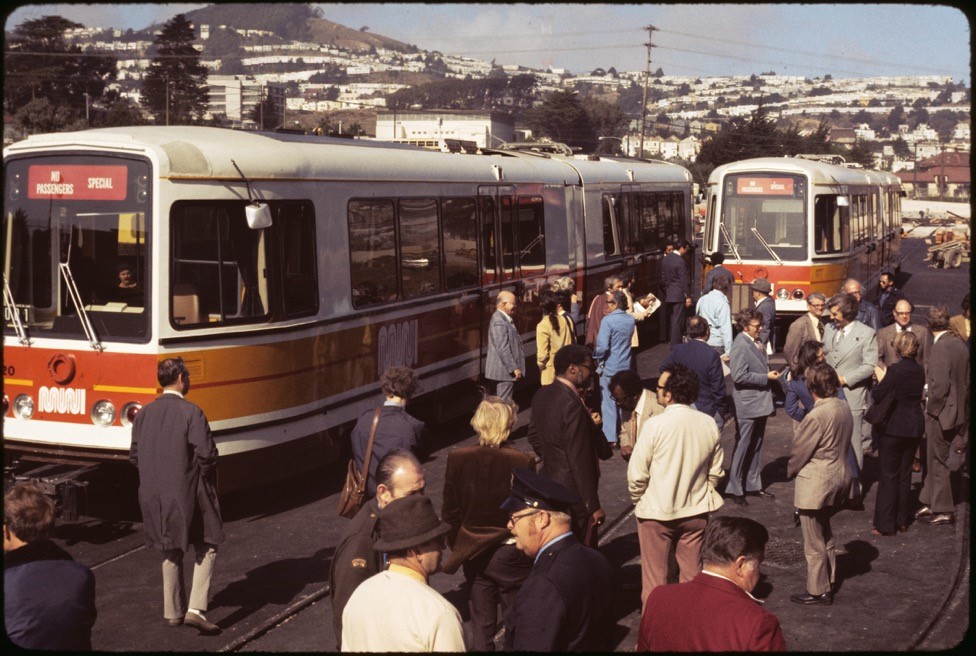
The arrival of Boeing LRVs came in October 1977 while the rail yard was still under construction. A small crowd of city officials, staff and press celebrated the arrival of the first two cars outside Green Division. In a short time over 100 LRVs would come to form the backbone of all Muni rail lines.

This October 24, 1977 photo shows Muni’s first two LRVs on display after arrival from the factory.

This October 24, 1977 photo shows Muni’s first two LRVs on display after arrival from the factory.

On July 11, 1979, Muni Metro Center was dedicated and a new fleet of LRVs waited in the yard to start serving the city. Just one year later, the Muni Metro system and Market Street Subway would open and the railyard’s key role in maintaining the new fleet would come into full effect.

1979 aerial shot looking southwest near San Jose and Ocean Avenues shows a newly completed Muni Metro Center and surrounding area

This November 1979 aerial shot looking southwest near San Jose and Ocean Avenues shows a newly completed Muni Metro Center and surrounding area.

On May 12, 1987, Muni Metro Center was re-dedicated as the “Curtis E. Green Light Rail Center” in honor of former Muni General Manager Curtis E. Green, who worked his way up from a bus driver to become the first African American appointed head of Muni.

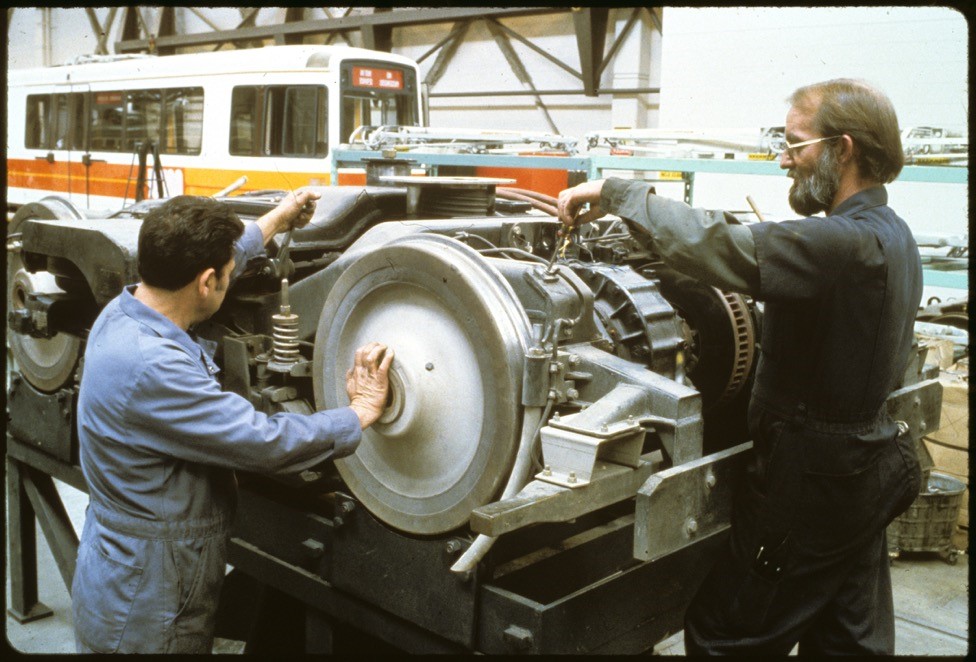
Green Division shop staff work on the truck from a Boeing LRV in this early 1980s photo.

Green Division shop staff work on the truck from a Boeing LRV in this early 1980s photo.

​​​​​​​Today, staff at Green Division carry on an over 100-year-old tradition started in 1907 with the United Railroads’ Elkton Shops. Working daily performing every job from routine maintenance and inspections to overhauling major components, the shops are critical to moving San Francisco.


Published November 24, 2021 at 11:40AM
https://ift.tt/3FJQadR

Labels: ,

Friday, November 19, 2021

Safer Intersections Project a Traffic Calming Success

Safer Intersections Project a Traffic Calming Success
By Uyen Ngo

mage from Vision Zero SF entitled “A Turn Toward Safety” with images of a person on a bicycle, a person walking a dog, a person pushing stroller with a baby in it, and a person on a scooter

This week the San Francisco Municipal Transportation Agency (SFMTA) released “A Turn Toward Safety: The Safer Intersections Project,” a report detailing the impact of the Left Turn Traffic Calming Project and the “Safety—It’s Your Turn” education campaign. The Safer Intersections Project now has tested traffic interventions that can reduce unsafe left turns. Overall, SFMTA found a 17% reduction in average speed (1.7mph slower) and a 71% reduction in the likelihood of a car turning left at higher speeds over 15mph at seven high-crash test intersections.

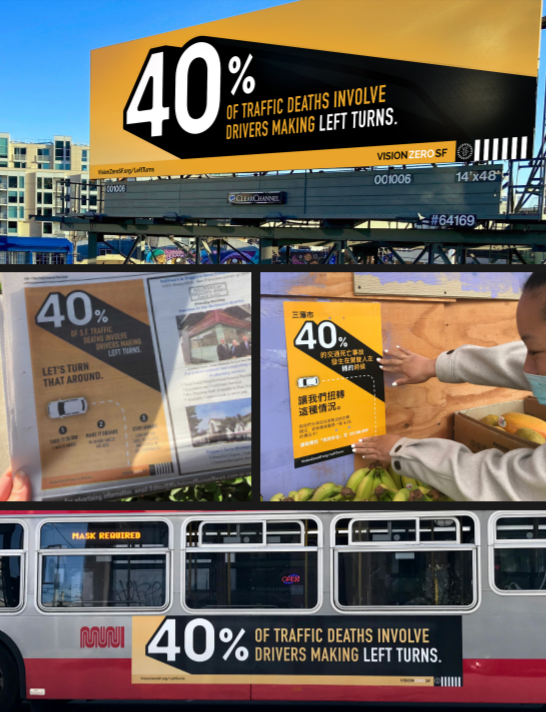
In 2019, 40% of traffic deaths in San Francisco were caused when drivers made left turns and didn’t see the person in the crosswalk, until it was too late. To combat this trend, also seen in other cities, and encourage safer left turns and adoption of safer left turn behaviors, San Francisco’s multilayered project combined engineering treatments in seven high-crash intersections with an education campaign, which led to promising results.

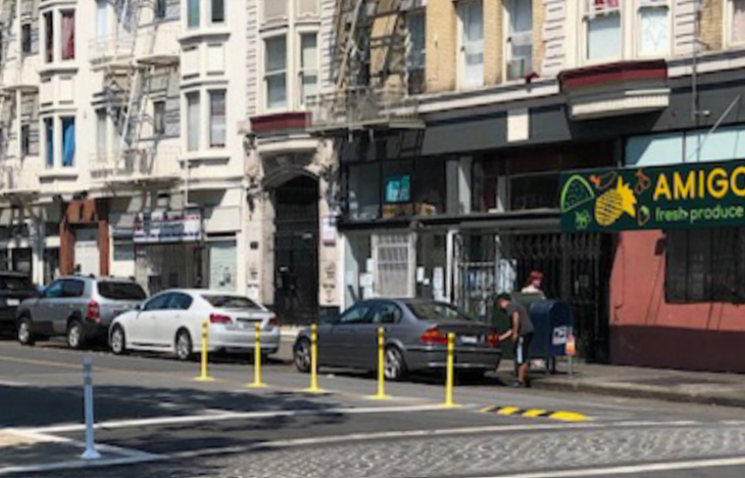
The Left Turn Traffic Calming Project consisted of installing waist-high vertical delineator posts, small rubber speed bumps, and paint to create enhanced center lane lines and painted safety zones to encourage slower, wider left turns and increase drivers’ awareness of other road users. To measure the impact, SFMTA collected left-turning driver speeds before and after installation and then compared driver speeds at the seven project intersections with four other control intersections. The result of this project showed that these treatments are proven to slow driver speeds and encourage safer left turns for both people in the crosswalks and opposing traffic.

photo of plastic safety posts separating a bike lane from a general traffic lane

The second part of the Safer Intersections Project was designing and implementing an education and community outreach campaign– “Safety—It’s Your Turn” –funded by a $2 million grant through the California Transportation Commission Active Transportation Program. The campaign presented three safer left turn behaviors (Take it slow—5mph is safest; Make it square—90-degree angles are best; and Stay aware—look out for cars, cyclists, and people) and data suggests the “Safety—It’s Your Turn” campaign extended the speed reductions from the Left Turns Traffic Calming project. Year-to-year survey results also show that public perception of the dangers of speeding is trending in the right direction, indicating a sustained change in attitudes influenced by education campaigns and engineering.

A unique aspect of this project was the use of behavioral science. SFMTA partnered with the Behavioral Insights Team (BIT), a leading behavioral science organization, to analyze how drivers make left turns in order to develop interventions that would prompt safer behaviors. By changing the architecture of intersections, we were able to move people toward making safer left turns in the moment. The combination of these physical changes and SFMTA’s educational campaign encouraged safe driving behaviors and increased awareness of how individual actions have an impact on the community.

montage of three posters and a sign on a bus that state 40% of traffic deaths involve drivers making left turns


The education campaign also included working with community-based organizations (CBOs) to broaden and deepen the traffic safety messaging. Through a community grant process, six CBOs were compensated for their time and knowledge, creating additional materials and events supporting the campaign. Many of our grantees were new to Vision Zero and helped us reach additional residents through creative ways such as food delivery, artistic public service announcements, virtual bike rides, and youth poster contests. Finally, we worked with an additional eight CBOs to share educational materials and present the Safety—It’s Your Turn campaign to their members.

In addition to the treatments’ impact on slower speeds, there were two key takeaways from the project:  

  1. Well-funded and evidenced-based education campaigns are an important and effective tool in in raising public awareness, encouraging safer driving behaviors, influencing policy discussions, and building community support.  
  2. For maximum effectiveness, calming treatments should become a standard engineering tool and applied at locations with existing high left-turn speeds, conducive street geometry, and lots of people walking and biking. 


Published November 19, 2021 at 10:28AM
https://ift.tt/3FyixLU

Labels: ,

Wednesday, November 17, 2021

4th and King Overhead Line Installation Starts November 17, 2021

4th and King Overhead Line Installation Starts November 17, 2021
By Enrique Aguilar

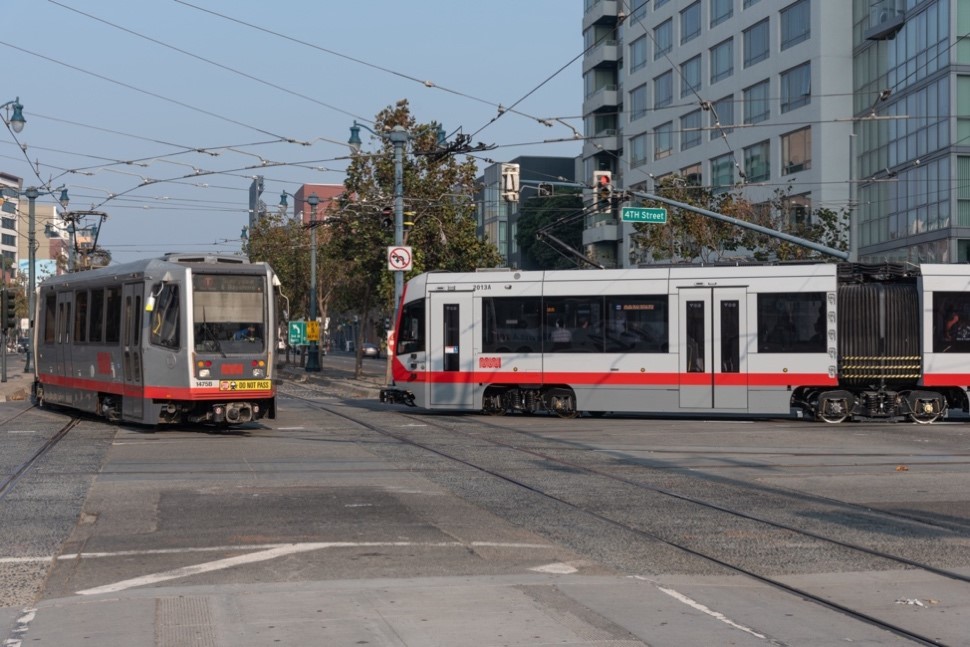
Photo showing two KT Ingleside-Third trains at the intersection of 4th and King streetsHeads up! Installation of overhead line equipment at 4th and King streets starts Nov. 17. Consider taking an alternative route if driving through the area as work for the Central Subway will require detouring traffic. N Judah and T Third rail service will be served by buses starting at approximately 9 p.m. each night that work is performed.
Crews are scheduled to work during nighttime to reduce traffic and Muni service disruption while overhead lines and accessories are installed that will tie the new Central Subway system to the existing T Third Street line. A test train will verify Overhead Catenary System (OCS) installation, which is how zero-emissions electrical power is supplied to light rail vehicles.

Electrical work will start at approximately 9 p.m. on Wednesday, Nov. 17, and should conclude Saturday, Nov. 20. Rail service will resume on schedule Thursday and Friday mornings. Saturday and Sunday rail service will resume later at approximately 8 a.m. The K Ingleside Bus will operate between Balboa Park and the Embarcadero. Customers will need to transfer to the N Judah Bus to continue to Caltrain or T Third Bus for destinations south of 4th and King. The T Third Bus will operate between Castro and Sunnydale and the N Judah Bus between La Playa and Caltrain.

Multilingual signs will be posted at train stops along the KT Ingleside-Third Street and N Judah routes to help Muni customers navigate these temporary service changes.

With 98% of the project completed, installing overhead line wires and equipment at 4th and King adds to a growing list of recent milestones. Other project accomplishments include fare gate and ticket vending machine installation at three underground stations and ongoing testing of critical systems, including train operation testing, which started in August. 

For more information please visit the Central Subway website.


Published November 17, 2021 at 10:54AM
https://ift.tt/3npudur

Labels: ,

Tuesday, November 16, 2021

San Francisco's Taxi Medallion Program Moves Onward

San Francisco's Taxi Medallion Program Moves Onward
By

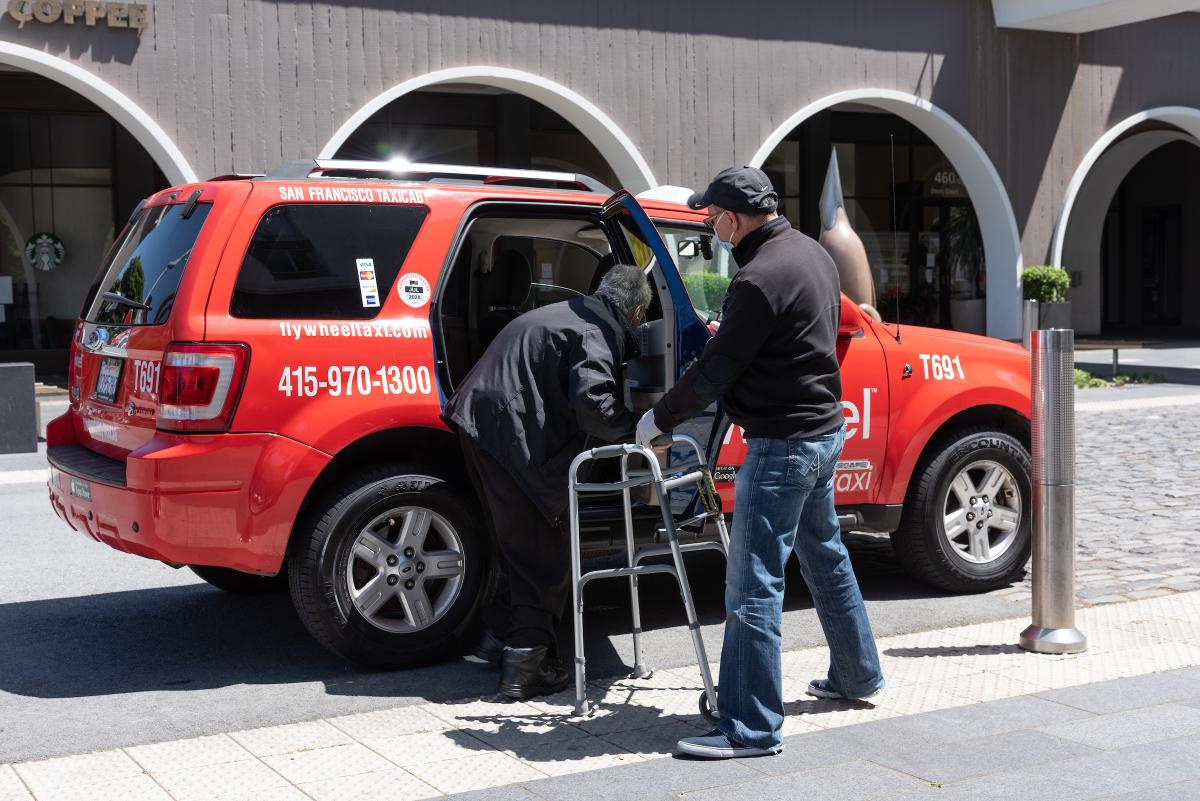
Photo of a taxi driver assisting a passenger with a walkerIn early October, a San Francisco jury found that the SFMTA did not breach its taxi medallion program Lender Agreements with the San Francisco Federal Credit Union.  Throughout this litigation, the SFMTA has continued to focus its attention on supporting purchased medallion holders and drivers.  In fact, over a year ago, the SFMTA made an offer to settle the lawsuit by providing millions of dollars in loan forgiveness to medallion holders.  Unfortunately, the SF Credit Union opted to continue its lawsuit against us.  With the trial now behind us, we are hopeful that the Credit Union will engage in the necessary dialogue with us and agree to participate in a loan forgiveness program. 
We understand the challenges faced by individuals who purchased taxi medallions.  Specifically, the fixed $250,000 price for a medallion is unsustainable, and needs to be lowered. Unfortunately, the SF Credit Union's Lender Agreement requires the Credit Union to consent to a lower price. For more than four years, the SFMTA has been advocating that the SF Credit Union allow us to lower the medallion sales price.   It is time for the Credit Union to work collaboratively with the SFMTA on a plan to do that. 

When taxis came under SFMTA’s umbrella in 2009, the method for distributing taxi medallions (a permit to operate a cab) was dysfunctional.  Until then, the fixed number of medallions available were distributed to taxi drivers in the order that they had placed their names on a list. There was fierce opposition to adding more permits, and the existing medallions were basically held for life. As a result, drivers could wait 15 years or more for their name to rise to the top of the waiting list. Proposition K, passed by voters in 1978, established a driving requirement for medallion holders, but many drivers were not in compliance. Adding to what was becoming a dysfunctional medallion system, the industry suffered from a reputation for poor customer service with no accountability.  

To help solve these longstanding challenges, the SFMTA established a pilot taxi medallion sale program in 2010. The early years of the program successfully allowed older medallion holders to retire, with a $200,000 windfall. Revenues from medallion sales went primarily to medallion holders and drivers (approximately $110M), and another $63M received by the SFMTA was applied toward supporting transit during the aftermath of the 2008-09 recession.  

The medallion sale program also allowed younger drivers to become small business owners by purchasing and holding a highly sought-after medallion.  

Unfortunately, a new and disruptive car service model was launched during this time, which allowed companies such as Uber and Lyft to begin operating in San Francisco outside the jurisdiction of the SMFTA and taxi industry rules.  Although the California Public Utilities Commission (CPUC) ultimately asserted jurisdiction over the “ride hail” industry, the framework they established ignored San Francisco’s taxi regulations (for example, the CPUC doesn’t require fingerprint background checks for drivers and they allow prices to change throughout the day).  Launched with incentives for drivers, seemingly unlimited venture capital advantage and free of oversight, the “ride hail” industry quickly came to dominate. 

The SFMTA Taxi Services team is focused on supporting the purchased medallion holders and drivers.  Already, taxis have become increasingly competitive in the market place.  We are eager to continue our work to simplify the medallion system in support of the purchased medallion program, promote improvements in customer service and support the competitiveness of the taxi industry.   This work is all the more important as taxis recover from the tremendous impact of the COVID-19 pandemic, and we hope the Credit Union will be part of the solution. 

We look forward to working with the industry in developing these reforms before presenting them to the SFMTA Board of Directors in 2022. 


Published November 16, 2021 at 01:52PM
https://ift.tt/3qJbhJd

Labels: ,

Thursday, November 4, 2021

Central Subway Readies Fare Gates and Ticket Vending Machines

Central Subway Readies Fare Gates and Ticket Vending Machines
By Enrique Aguilar

In October, crews began installing and testing fare gate and ticket vending machine equipment at new underground stations that hundreds of Muni customers will use to pay for Muni fares once the Central Subway opens next year.

In addition to the new equipment being put into place at Chinatown/Rose Pak, Union Square/Market Street and Yerba Buena/Moscone stations, we are also continuing the train testing necessary to help us reach our goal of beginning service in 2022.

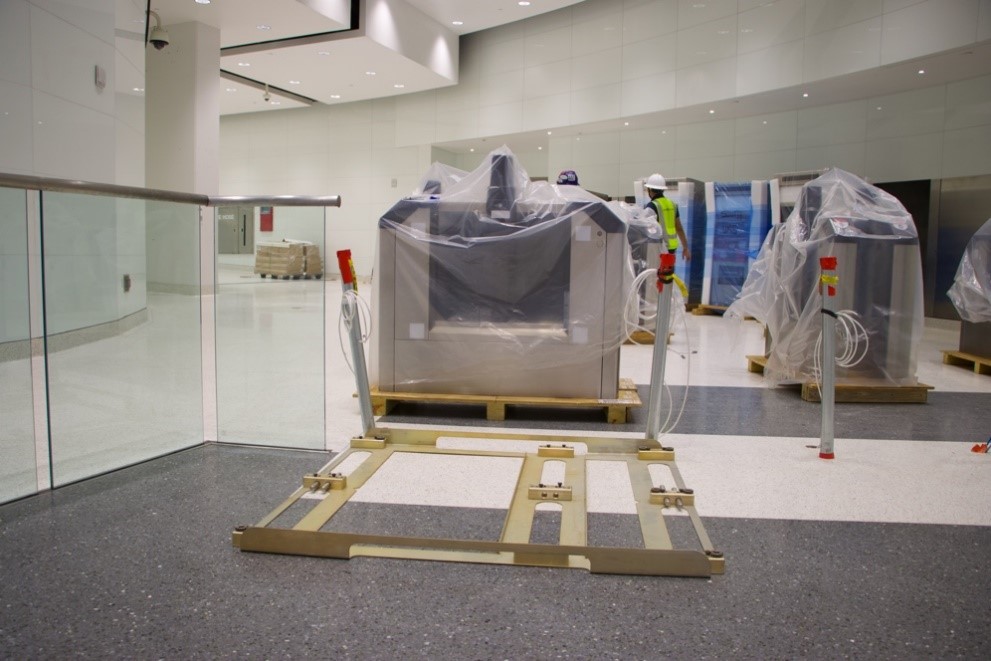
From the earliest stages of planning, our infrastructure design took into account the need for revenue management equipment like gates and fare machines. Like appliance placement in a brand-new home, architects developed the layout which construction workers build-out of the station’s interior. Crews will secure equipment, connect it to power and data sources and ensure cabling is in the appropriate location based on the station’s floor plan.

With construction winding down, the new equipment can now be bolted to the floor and any infrastructure adjustments can be made as needed. Network engineers at the SFMTA have also built the fiber-optic data network that will connect Central Subway stations to our central data system.

photo of drilling template used to place vending machine equipment

Drilling template for fare gates at Union Square/Market Street Station

If you ride Muni Metro via stations between Van Ness and Embarcadero, then you are likely familiar with the self-serve machines near station entrances allowing Muni customers to load value on  Clipper for iPhone and Android devices before tapping at fare gates leading to a station’s platform level. The Central Subway’s ticket vending machines and fare gates are identical to those found at other underground Metro stations and customers will pay for fares just like anywhere else in the system.

photo of faregates installed at Central Subway stationRecently installed fare gates near south entrance of Union Square/Market Street Station

Testing of fare gates and ticket vending machines will begin soon after installation as a part of the project’s current phase of testing critical systems.

To receive project updates via email or text, please sign up at the Central Subway webpage.


Published November 04, 2021 at 09:31AM
https://ift.tt/3bWsOoJ

Labels: ,

Friday, October 29, 2021

Slow Streets Become Spooky (Safe) Streets for Halloween

Slow Streets Become Spooky (Safe) Streets for Halloween
By Eillie Anzilotti

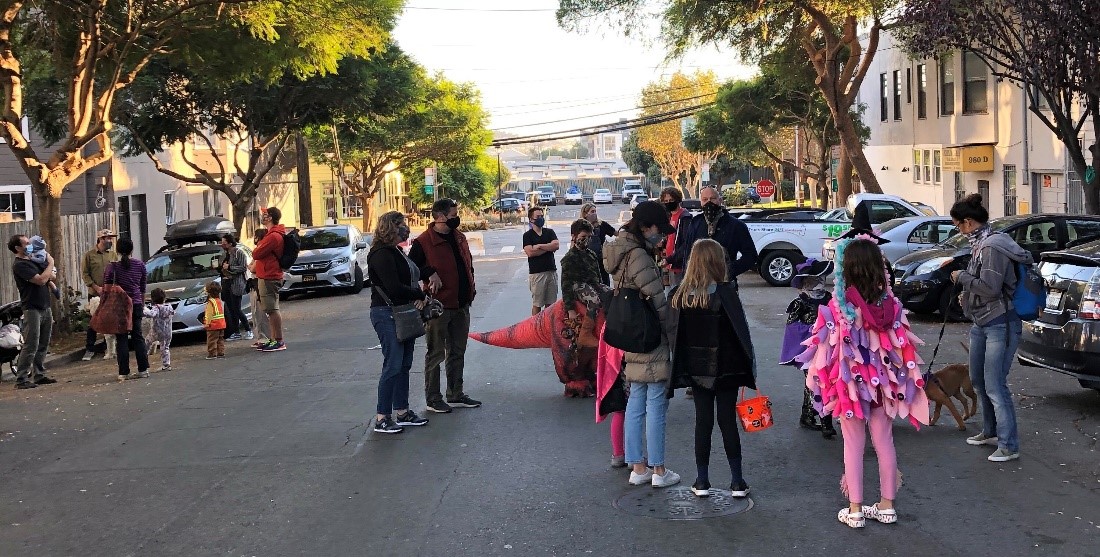
Photo of children in Halloween costumes on Minnesota Street in 2020

Halloween festivities on Minnesota Slow Street in 2020

This Halloween season, Slow Streets are becoming Spooky Streets. All across San Francisco, community groups are transforming their local Slow Streets into neighborhood gathering places for trick-or-treating, costume parties and more.

On October 31 from 3 to 6 p.m., organizers from Kid Safe SF and the Great Highway Park Initiative are turning the Great Highway into The Great Hauntway, a beachside block party with a costume contest, arts and crafts and a “spooky disco.” That same day, neighbors in Sunnyside are gathering on Slow Hearst Street for a Halloween party at 4 p.m. On Minnesota Street, the Dogpatch Neighborhood Association is hosting their second annual MinneSLOWta Spooky Slow Street Stroll on October 30—the same day that Slow Sanchez Street will host a Halloween Stroll.

Safe, car-light spaces for people to walk, bike and roll are essential every day, but especially on Halloween. Statistically, this holiday that revolves around children being out in the streets, often later in the evening, is the most dangerous day of the year for young pedestrians. To create safer conditions on San Francisco streets for little vampires, ghosts and witches, the SFMTA encourages people to bike, walk or take Muni on Halloween—and for people who do have to drive to use extra caution. Because Outside Lands falls during Halloween weekend this year, the SFMTA is offering expanded, coordinated service between Muni and BART to enable people to opt for transit and keep streets safer.

Slow Streets add an additional layer of safety—which explains their popularity as Halloween gathering places. On Slow Streets corridors, vehicle traffic is designed to be limited to local access and through traffic is discouraged. Just recently, the Slow Streets team released its Evaluation Summary Report containing data on the past year of the program, which was launched initially as an emergency response to the COVID-19 pandemic, but supports SFMTA’s larger Vision Zero goals of ending traffic fatalities on city streets. Around 71% of San Francisco residents surveyed reported that their street became safer after being designated as a Slow Streets street. Programmatic data analysis shows that Slow Streets see a 35% decrease in daily traffic and a 14% decrease in vehicle speeds—along with a 36% decrease, on average, in collisions across the Slow Streets network. As conditions on Slow Streets corridors improved, more and more people--especially kids--felt safe biking and walking along them.

Last Halloween was the first year that neighborhoods had the option to celebrate with Slow Streets—and so many did. We’re thrilled to see the tradition continue this year, and hope everyone has a safe, spooky Halloween!

Hosting or attending a Halloween event on a Slow Street near you? We would love to learn about it and see pictures from the celebration! Get in touch at SlowStreets@SFMTA.com


Published October 29, 2021 at 10:29AM
https://ift.tt/3vWCoRn

Labels: ,

Tuesday, October 26, 2021

Animated Map Shows Record Expansion of Transit Lanes

Animated Map Shows Record Expansion of Transit Lanes
By Michael Rhodes

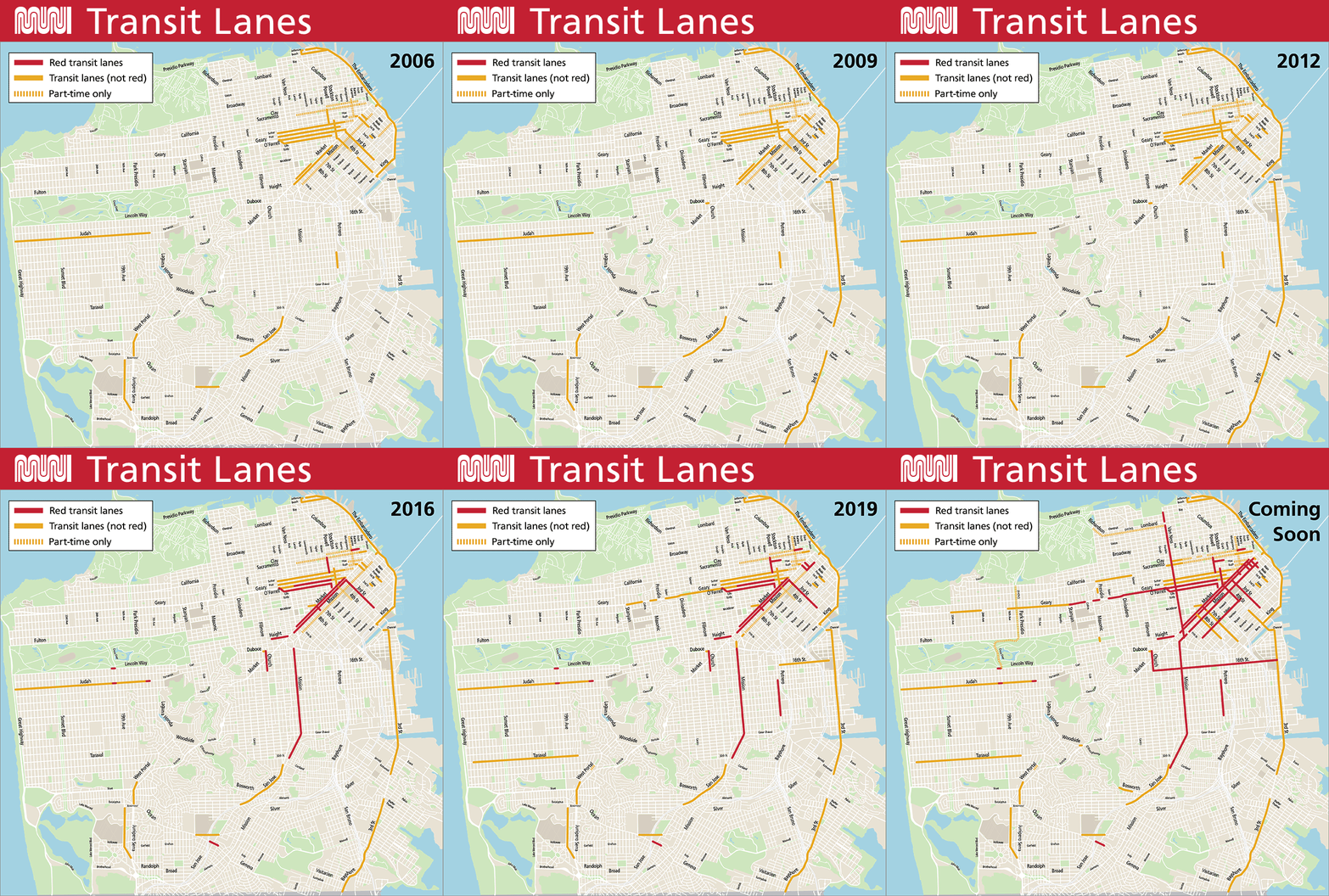
A map showing the expansion of transit lanes in San Francisco from 2006 to 2021, as well as lanes that are coming soon. A summary of key highlights from the map is included in the accompanying blog post.

An animated map showing the expansion of transit lanes in San Francisco. View as a PDF.

It’s been a record year for transit lanes in San Francisco: we’ve installed nearly 14 miles of new or upgraded lanes since summer 2020. That’s the fastest expansion of transit lanes in the city’s history. These transit lanes benefit Muni routes that serve nearly two-thirds of current customers. It’s all part of our efforts to give transit riders priority on congested streets and improve Muni speed and reliability. Better Muni service means more people will opt to take transit instead of driving, that reduces congestion and supports our environmental goals.

To commemorate this milestone, we’ve put together an animated map showing the evolution of San Francisco’s transit lane network over the last 15 years. We hope you find it as mesmerizing as we do to watch transit lanes expand across the city during this time.

Transit lanes are dedicated to Muni vehicles as well as other buses and taxis in most cases. They help improve Muni’s travel time and reliability and protect transit riders from traffic congestion. Red transit lanes were first introduced in San Francisco in 2013 and have proven to be even more effective than non-red transit lanes, leading to about a 50% reduction in violations.

We’ve been steadily adding to the transit lane network since the 1970s, when the original Transit First Policy was adopted, but the past five years have been especially busy. And as the final map shows, many more transit lanes are fully approved and coming soon, including the much anticipated Van Ness Avenue transit lanes.

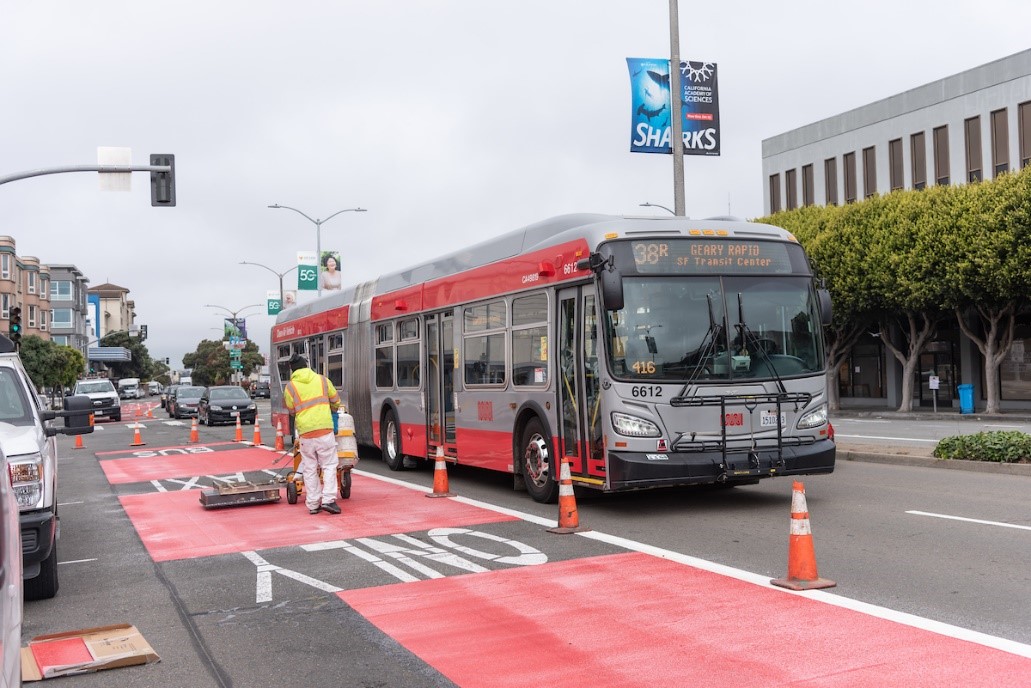
SFMTA paint shop crews install new red transit lanes on Geary Boulevard

An SFMTA paint shop crew installs new red transit lane on Geary Boulevard

A few highlights to look out for in the map:

  • Transit lanes on the T Third, installed as part of the line’s launch in 2007
  • The city’s first red transit lanes, installed on Church Street in 2013
  • The major expansion of red transit lanes in 2014, including Geary, O’Farrell, Market, Haight and 3rd streets
  • The evolution of Market Street in downtown from a short segment of transit lanes in 2006 to full transit lane coverage by 2021
  • The extension of transit lanes on Geary Boulevard, our busiest bus corridor, in 2018 and 2020 to cover nearly the entire 38 Geary /38R Geary Rapid  lines (with more red paint on its way!)
  • The upgrading of existing transit lanes on Mission Street in SoMa from part-time to 24/7 in SoMa in 2021 (soon to be upgraded with red paint)
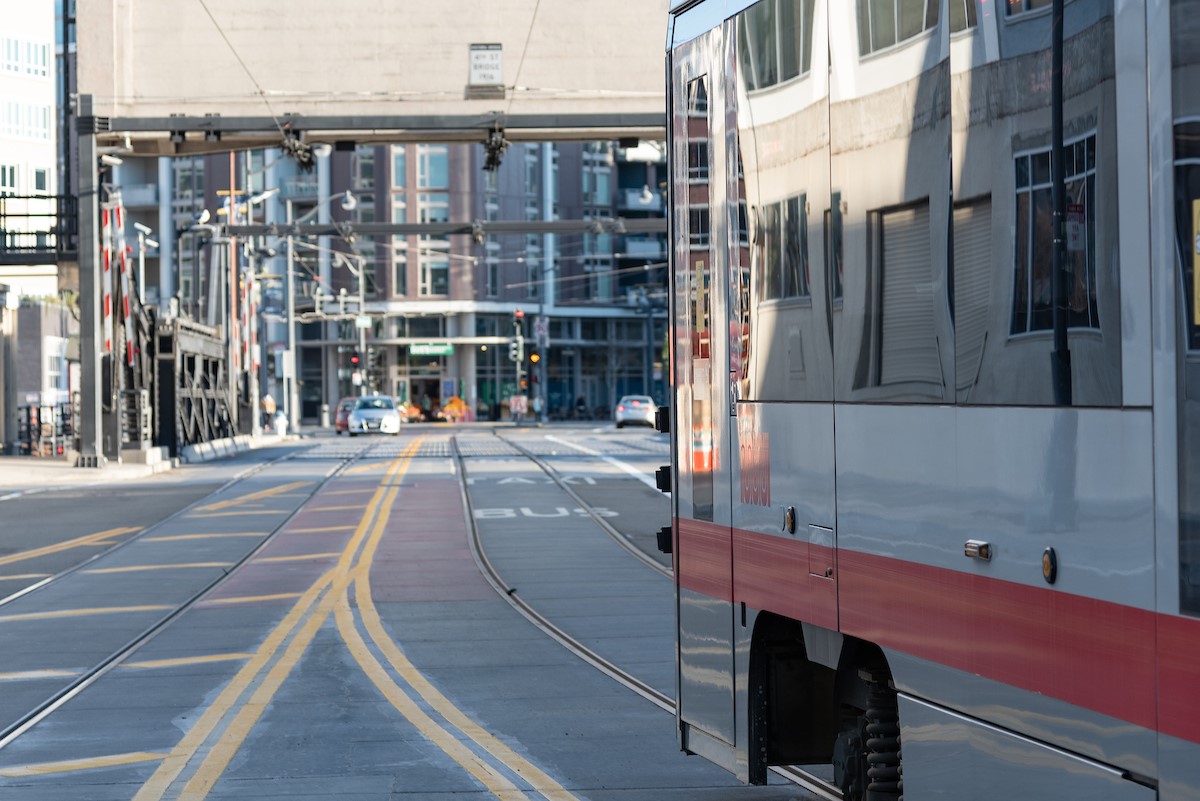
  • A short but important new transit lane on the 4th Street bridge added in 2021, filling a key gap in the T Third’s transit lanes
  • The record-setting expansion of transit lanes in 2020 and 2021 as part of our Temporary Emergency Transit Lanes program, which benefits nearly half of all current Muni riders
  • The state’s first urban arterial HOV lanes, installed on Lombard Street in September 2021

photo of train on a new transit lane on the historic 4th Street BridgeA train crosses a new transit lane on the historic 4th Street Bridge
What’s Next

Transit lanes have proven their worth in getting Muni riders where they’re going faster yet again this year, and more are on the way. In addition to installing transit lanes that are already approved, we’ll be starting outreach on a new round of Muni Forward projects in the coming year to deliver faster, more reliable and less crowded service to Muni customers. These projects will include transit lanes and other transit priority measures that keep Muni moving. Sign up for our Muni Forward mailing list to receive updates about new transit lanes coming your way.

Map Notes

For those who can’t get enough detail about transit lanes, here are a few more notes about how we created the map:

  • We didn’t differentiate between one-way and two-way transit lanes on the map, except on Market Street
  • We included any dedicated lane within a city street as a transit lane, including rail tracks that can’t be used by buses. Subways, tunnels and rail rights-of-way that are entirely separate from any roadway (such as the J Church right-of-way through Dolores Park) were not included.
  • We included HOV lanes on Lombard that serve the 28 19th Avenue bus line, but didn’t include a short stretch of HOV lane on Bryant Street because it’s not used by transit
  • In a few cases, transit lanes go away temporarily during roadway construction, such as on 4th Street for the Central Subway. In rare cases, transit lanes are removed because transit is rerouted to a new street, such as the transit lane on Harrison Street that served the old 12 Folsom route before it was eventually rerouted a block north to Folsom Street.
  • Not all approved Temporary Emergency Transit Lanes on the 43 and 44 lines are shown as we’re monitoring transit performance to help us determine when to move forward with these lanes. Learn more on the 43/44 TETL project webpage.


Published October 26, 2021 at 01:02PM
https://ift.tt/2ZuiUYw

Labels: ,

Monday, October 25, 2021

70 Years at Elkton Shops: Part 1

70 Years at Elkton Shops: Part 1
By Jeremy Menzies

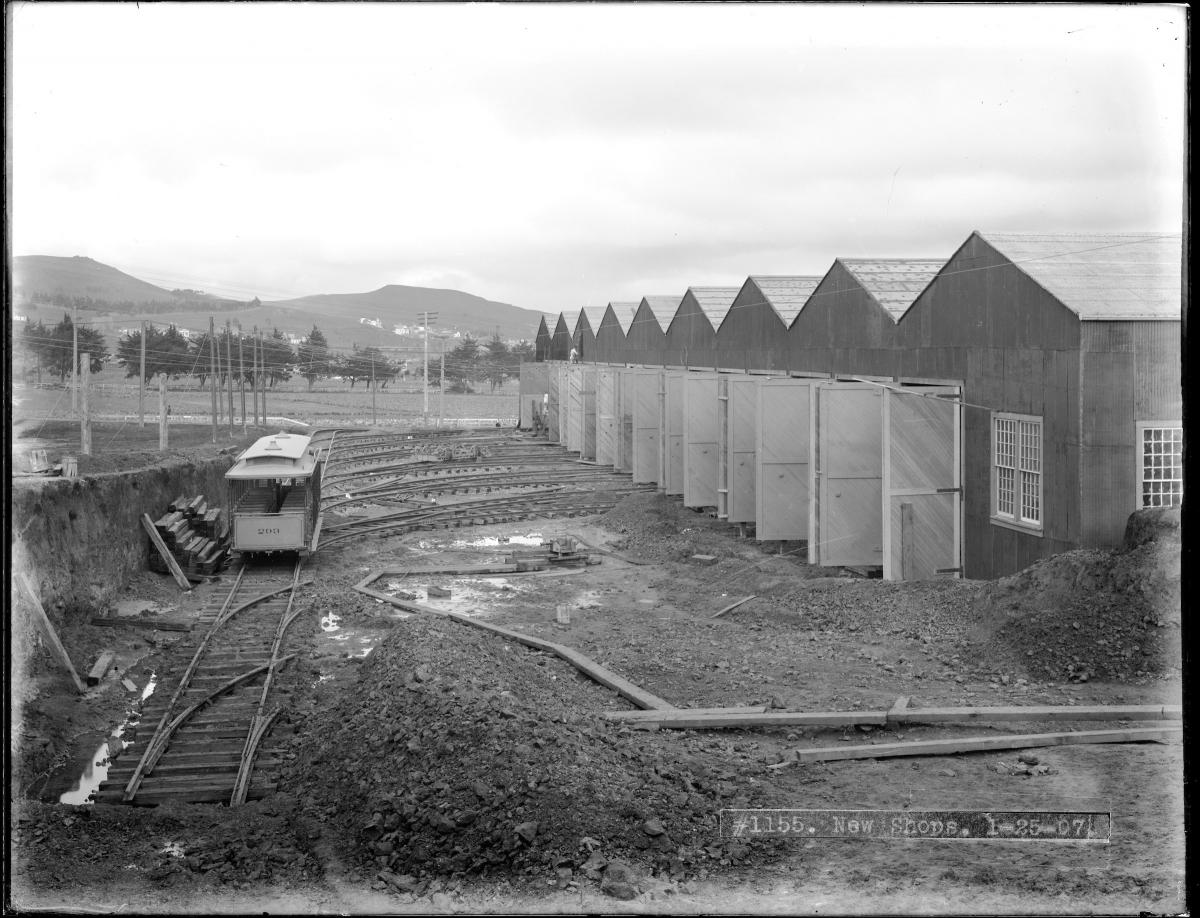
In this two-part blog series, we will look back at the history of one of our city’s hardest working transportation properties. For almost 115 years, the Elkton lot, located on San Jose Avenue between Ocean and Niagara Avenues, has been the epicenter of SF streetcar operations. In this post, we will explore the first 70 years at the property when it was known as “Elkton Shops”.

Built between 1905 and 1907 by the United Railroads of San Francisco (URR) on a several acre field in the outskirts of the city, Elkton Shops was the most comprehensive transit facility in the city. The new shops, mainly surrounded by farmland, were named after a Southern Pacific Railroad stop just steps away on Ocean Avenue.

A lone cable car sits on a muddy ladder track outside the newly built Elkton Shops in this January 1907 shot.A lone cable car sits on a muddy ladder track outside the newly built Elkton Shops in this January 1907 shot.
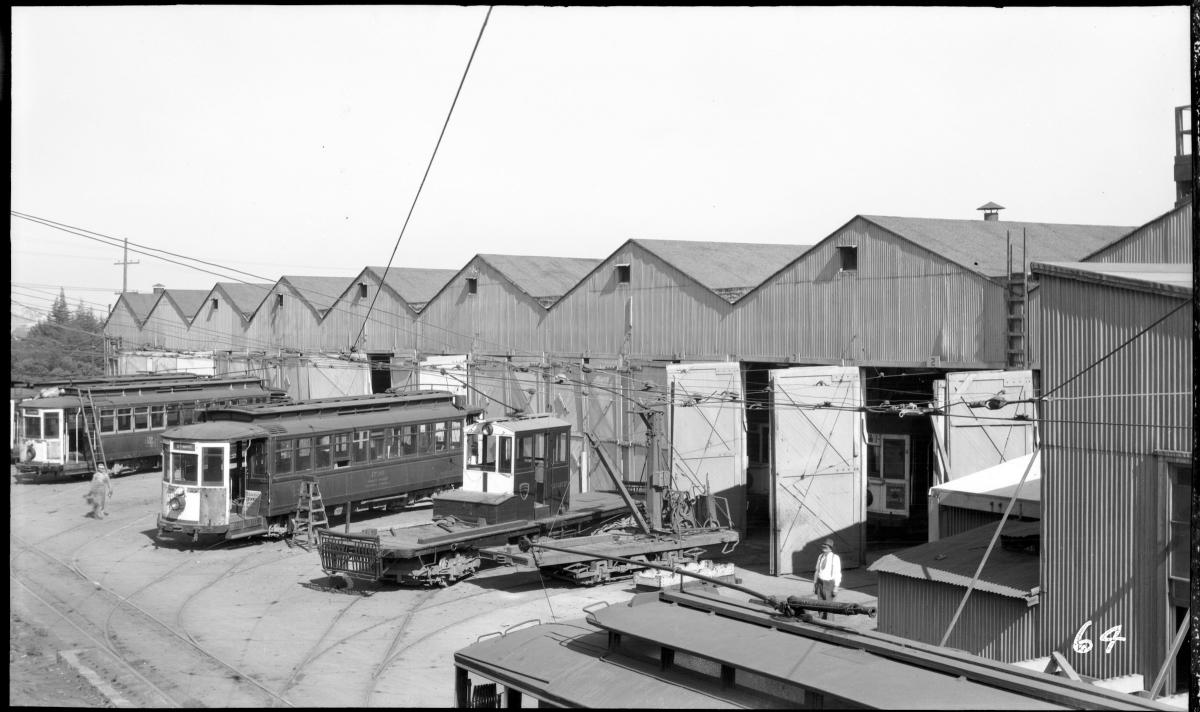
In 1921, Elkton changed hands, going to the Market Street Railway Company after URR suffered years of financial troubles. During its heyday in the 1920s, Elkton Shops was a powerhouse of repair and production. A staff of over 350 people were responsible for building and overhauling hundreds of streetcars and cable cars to keep the railway’s sprawling system running.

This 1928 photo was taken at the peak of production at Elkton Shops when staff was turning out 26 brand new cars a year on top of 316 complete overhauls and myriad other work.This 1928 photo was taken at the peak of production at Elkton Shops when staff was turning out 26 brand new cars a year on top of 316 complete overhauls and myriad other work.
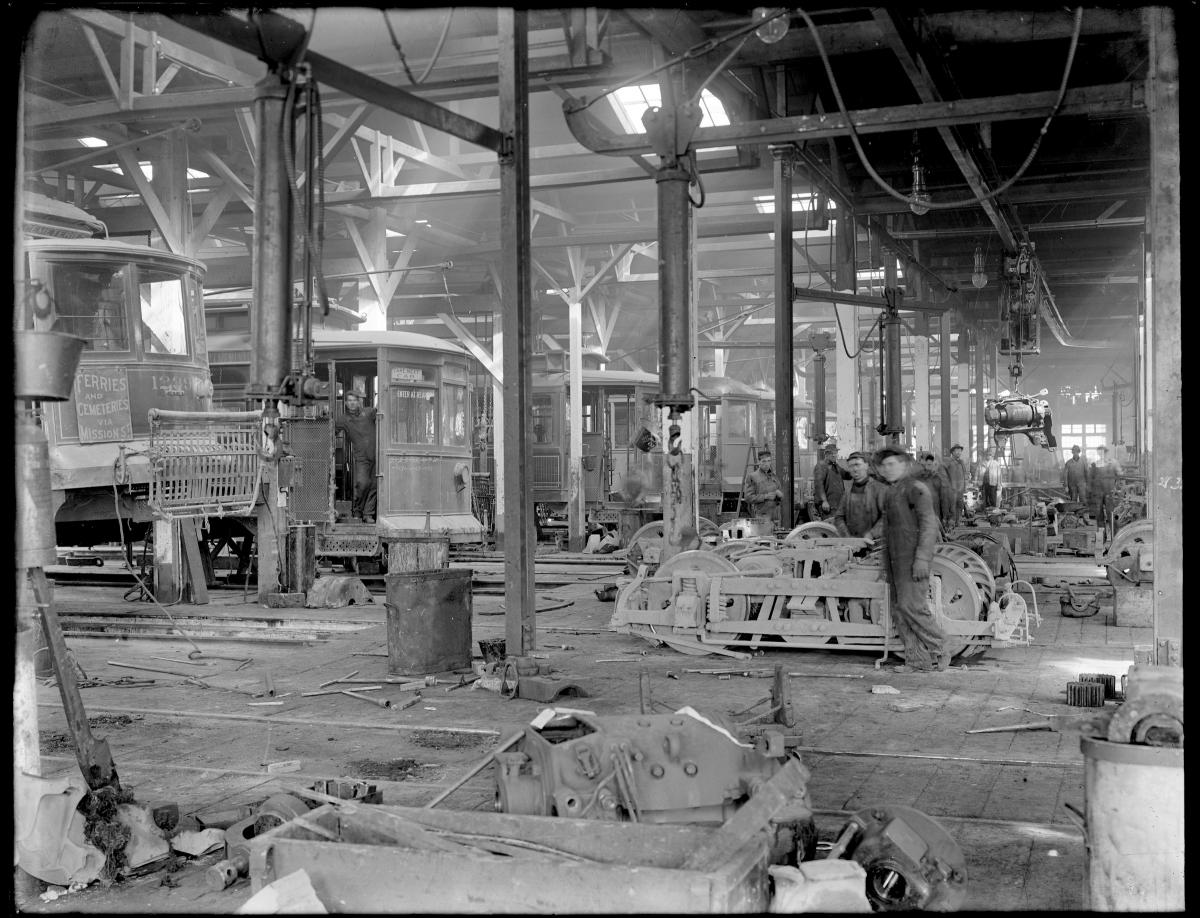
Every type of job from replacing broken windows and upholstering seats to machining wheels, overhauling electric motors, and painting cars was performed in the shops. According to a 1928 article in the company’s newsletter, the average time it took to completely overhaul a streetcar at Elkton was 19 days. On average, 22 cars would be in the shops undergoing the process at any one time.

A view inside the overhaul shop in 1912 showing a row of streetcars at left and staff tearing down trucks and motors at right.A view inside the overhaul shop in 1912 showing a row of streetcars at left and staff tearing down trucks and motors at right.
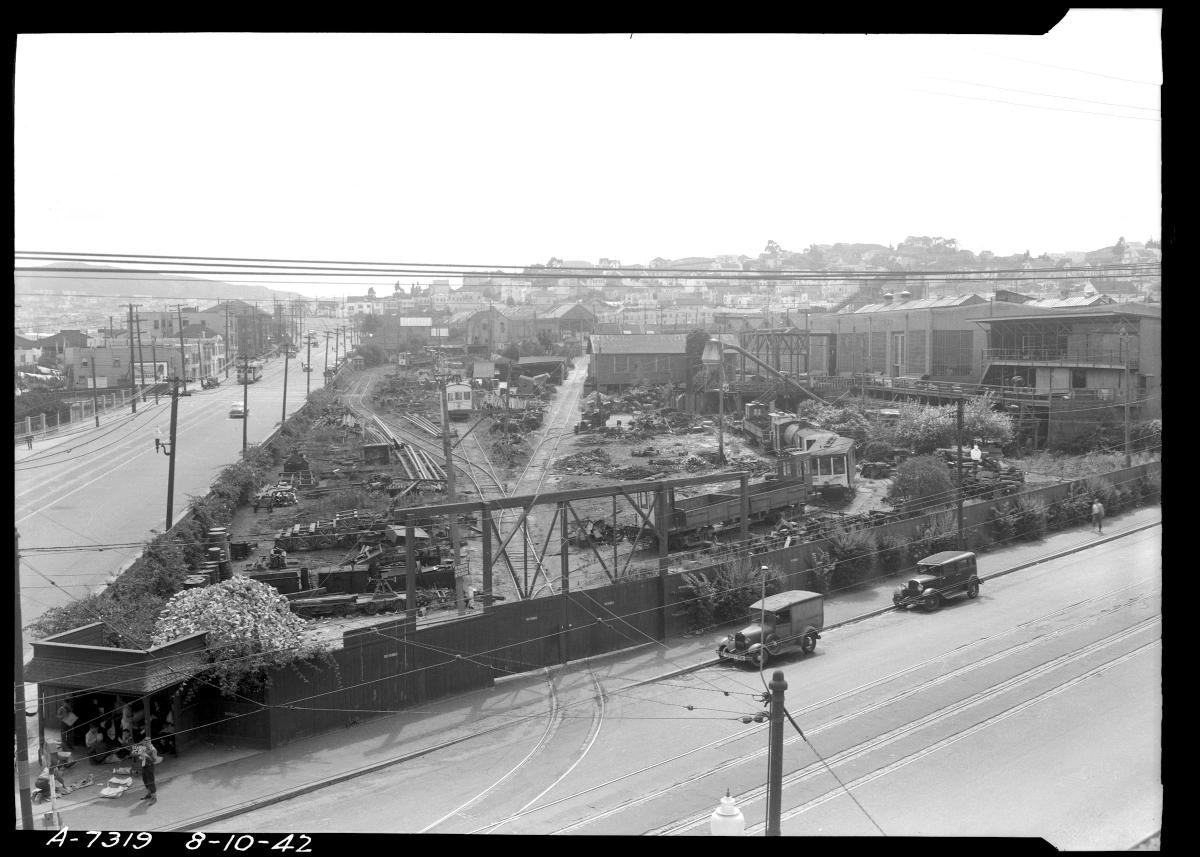
In 1944, the Market Street Railway Co. was purchased by the city and Elkton became a part of the now greatly expanded San Francisco Municipal Railway. The heyday of streetcars would soon be coming to an end but the ramshackle old shops continued to hold a valuable place in the future of Muni.

A view inside the overhaul shop in 1912 showing a row of streetcars at left and staff tearing down trucks and motors at right.This 1942 shot shows Elkton’s rear yard crowded with everything from cobblestones to streetcar wheels.
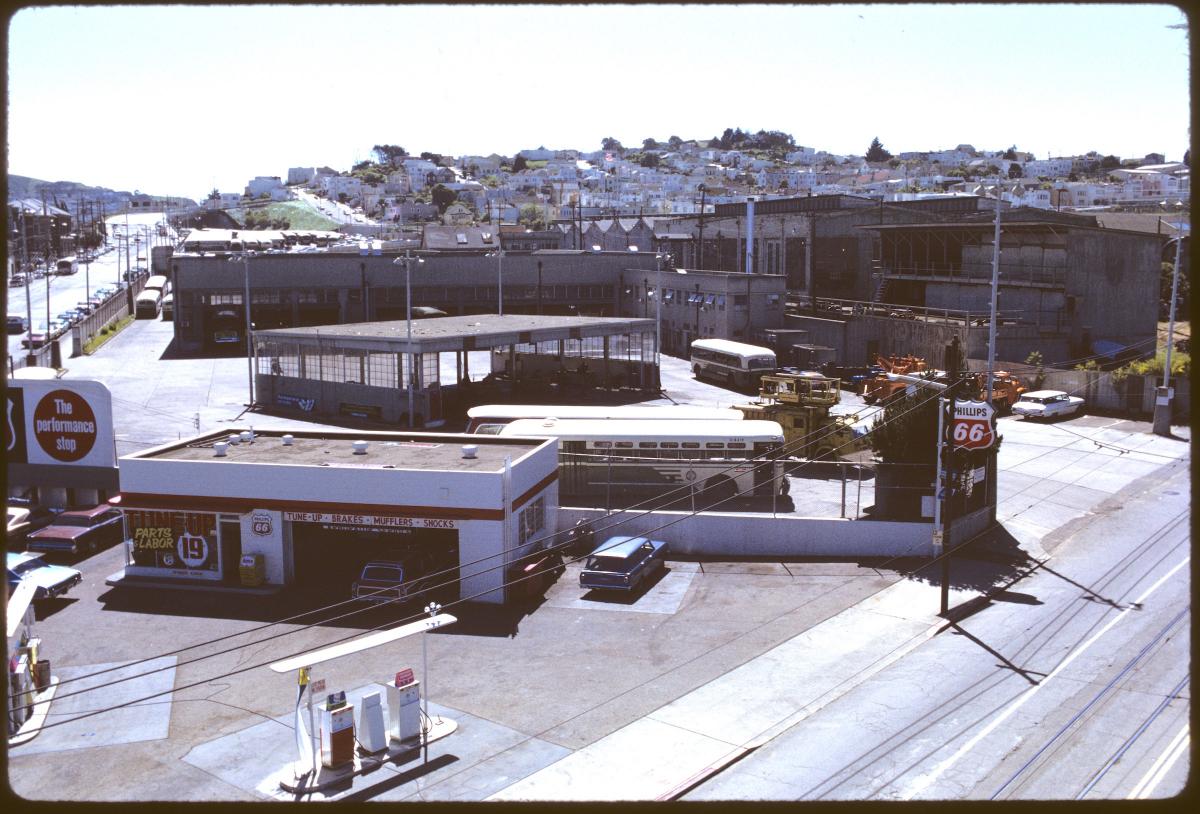
Following World War II, Muni began quickly expanding its bus fleet and in 1948, Elkton’s rear yard was cleared and excavated to build the Ocean Division bus yard. The new yard would provide fueling, maintenance and storage for Muni’s growing fleet, including newly leased Mack buses. Elkton Shops remained in service next to the bus yard for another two decades.

Looking southwest from San Jose and Ocean Avenues, this view shows Muni’s Ocean Division in 1972. At the left is a service station, center the fueling and shop buildings and at right are the Elkton Shops.Looking southwest from San Jose and Ocean Avenues, this view shows Muni’s Ocean Division in 1972. At the left is a service station, center the fueling and shop buildings and at right are the Elkton Shops.
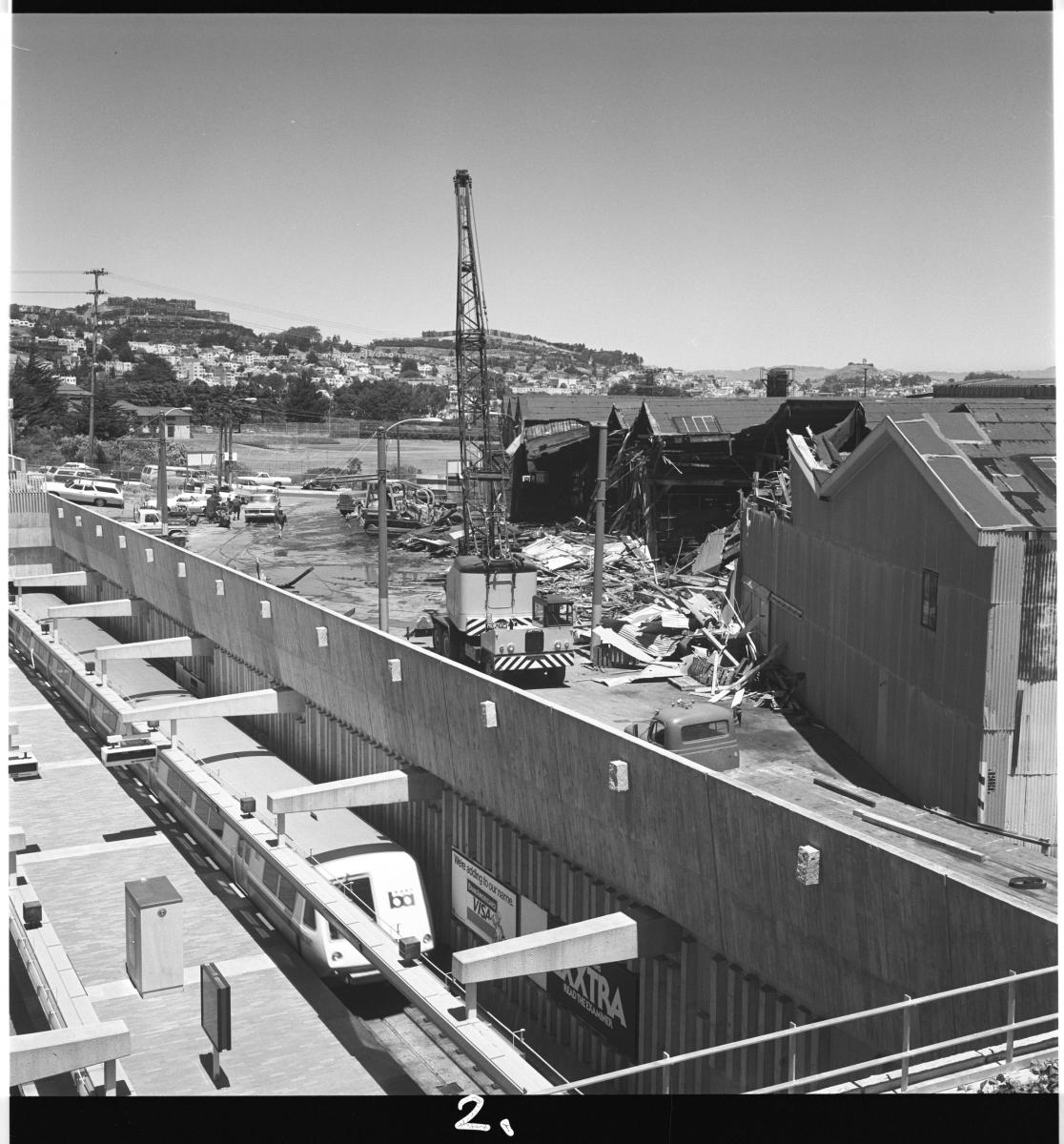
The death knell for Elkton occurred in the mid-1970s as the city moved to bring Muni Metro to life with “light rail vehicles.” As these new trains travelled through a subway underneath Market Street, Muni needed a new facility to house and maintain this brand-new fleet. In 1975, Ocean Division was demolished and construction began on what would become the city’s first modern rail repair shop. Just two years later on May 27, 1977, workers at Elkton Shops punched their last timecards in the run-down old building. Four days later, the huge turn of the century shop buildings met their fate with the wrecking ball.

The end of an era came on May 31, 1977 when Elkton Shops was torn down after 70 years of service. In less than 3 years, a rail yard filled with brand new light rail vehicles would stand in place of the old shop buildings.The end of an era came on May 31, 1977 when Elkton Shops was torn down after 70 years of service. In less than 3 years, a rail yard filled with brand new light rail vehicles would stand in place of the old shop buildings.
Tune in next month for part two of this series and learn about the next phase of life at this storied property.


Published October 25, 2021 at 01:09PM
https://ift.tt/2ZsJG3E

Labels: ,

Monday, October 18, 2021

18,000 Upgraded Parking Meters are Coming Citywide

18,000 Upgraded Parking Meters are Coming Citywide
By Jessie Liang

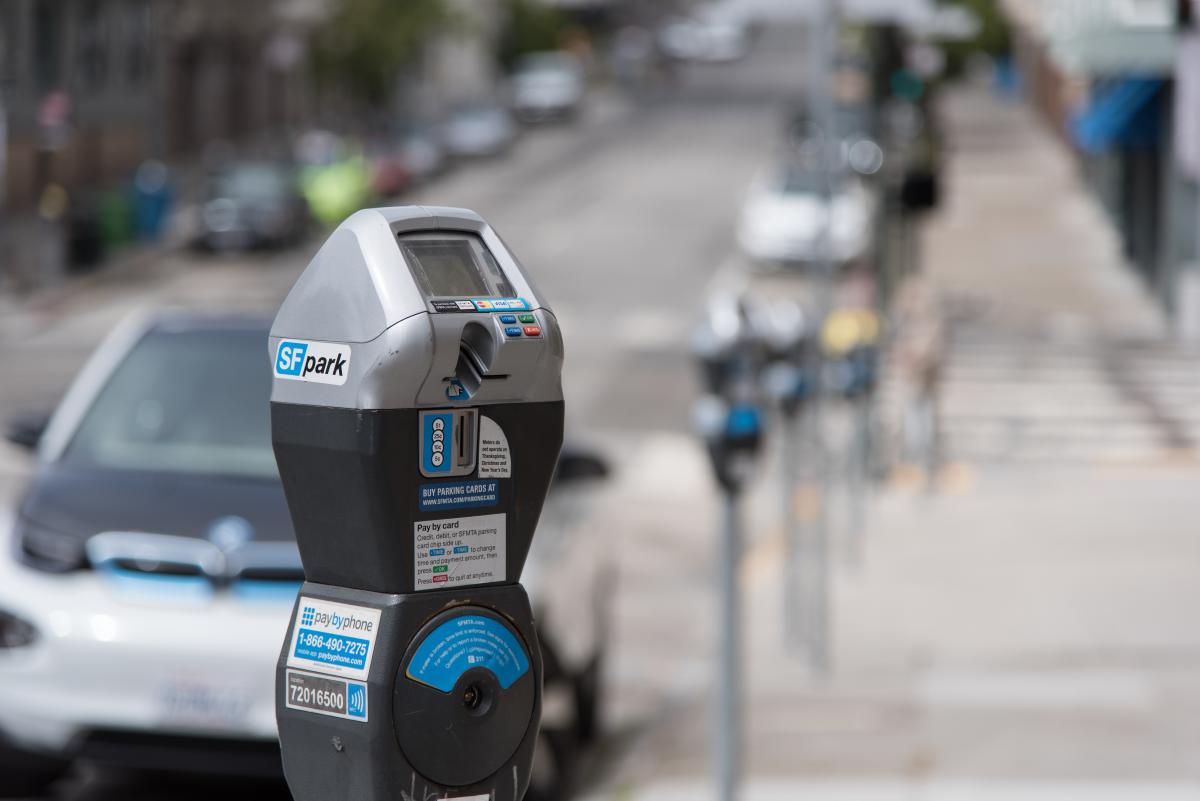
Photo of a parking meterBeginning early next year, SFMTA will be replacing more than 18,000 parking meters throughout San Francisco. The parking meter hardware upgrade is taking place under a $70 million contract with MacKay Meters, Inc, which was approved by the Board of Supervisors. According to the agreement, more than half of the 28,000 paid parking spaces in San Francisco will see their meters replaced. With this project we expect to save an estimated $6 million in operating costs over the next decade. 
The new meters will improve the user experience by providing a wider and brighter screen, accepting contactless payment, and allowing customers to receive a parking receipt via text message. 

Many of the city’s parking meters and paystations purchased in 2014 are nearing the end of their useful life due to subsequent technology improvements and the age of the hardware. In addition, the existing meter hardware was equipped with outdated 3G technology to communicate payment and maintenance information which will no longer be supported by service providers after the end of 2022. 

The new meter technology will transmit data more efficiently and accurately, which not only reduces the cost of maintenance but also saves operating costs of maintaining an aging system.

 The SFMTA manages 23,500 single-space and 4,500 multi-space metered parking spaces for vehicles and motorcycles under the Agency’s jurisdiction and for the Port of San Francisco. The agreement authorizes the SFMTA to procure approximately 16,000 single-space parking meters and 2,200 multi-space paystations, associated Meter Management Systems (MMS), and vendor support services including programming and integration with other parking management systems. 

The replacement work of parking meters will start from February 2022. For more information about parking meters, please visit the SFMTA parking website. 


Published October 18, 2021 at 12:51PM
https://ift.tt/3BVxp5E

Labels: ,

Thursday, October 14, 2021

Sunday Streets Returns October 17, with Phoenix Day

Sunday Streets Returns October 17, with Phoenix Day
By Pamela Johnson

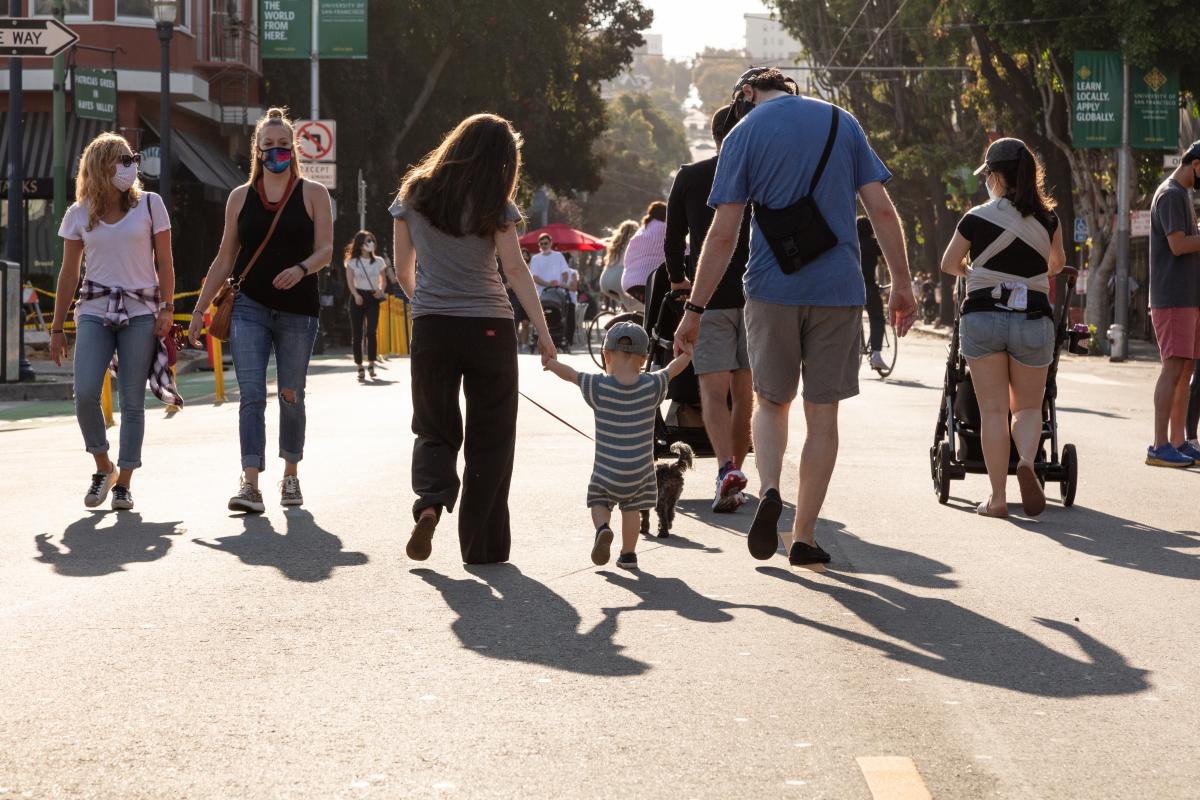
Images of pedestrians and people on bicycles enjoying a car free streetFor 13 years, the SFMTA and Livable City have brought "Sunday Streets" to San Francisco neighborhoods. Sunday Streets encourages communities to transform miles of car-congested streets into car-free spaces for neighbors to gather, kids to play, and for organizations and businesses to connect. On October 17, 2021, after more than 18 months of Covid-related shutdowns, Sunday Streets Phoenix Day will again bring free recreational activities, resources, and fun to the streets for tens of thousands of San Franciscans to enjoy. While Sunday Streets was celebrated in one neighborhood at a time in the past, this year's Phoenix Day spans various districts in the City for a simultaneous celebration of community, health, and resilience. This year's theme is "One City. One day. Rising together.”

 Highlights this year include historic Sunday Streets SF routes, a 20+ mile community bike ride, three neighbor-run block parties, pop-ups, and free community-hosted activities across the city. Along the way, participants will be offered free health and wellness activities as well as cultural offerings and open space for the whole family to enjoy.  As part of the block party program for Phoenix Day, the City has issued more than 30 permits for neighbors from different communities to participate in the day's festivities.

 Phoenix Day is about communities coming together to celebrate healthy fun as San Francisco reopens during the COVID-19 pandemic. Supporting the City’s economic recovery and its residents physical and mental health includes bringing joy back to our communities as we gather again outside to have fun with family and friends. At the same time, we are committed to keeping our community safe from COVID-19 and encourage people to wear masks in crowded outdoor spaces and always indoors, use hand sanitizer, and stay home if they are sick.

 In this critical moment for San Francisco it's more important than ever to transform our streets into places that foster human connection and civic pride. Sunday Streets Phoenix Day will be a monumental opportunity to do that together. 

About Sunday Streets

In 2008 the Sunday Streets SF program was started as a one-day pilot by then Mayor Gavin Newsom and the SF ShapeUp Coalition. It was inspired by the La Ciclovía initiative in the Colombian capital of Bogotá.  Since starting the program in 2008, the nonprofit Livable City in partnership with SFMTA and City and County of San Francisco has grown Sunday Streets into one of North America’s premiere open street programs serving 100,000 residents in diverse neighborhoods across San Francisco.

Visit Sunday Streets SF Phoenix Day to learn more.


Published October 14, 2021 at 12:11PM
https://ift.tt/3AFzlxW

Labels: ,

Monday, October 4, 2021

Warriors Ticket Holders Ride for Free

Warriors Ticket Holders Ride for Free
By Stephen Chun

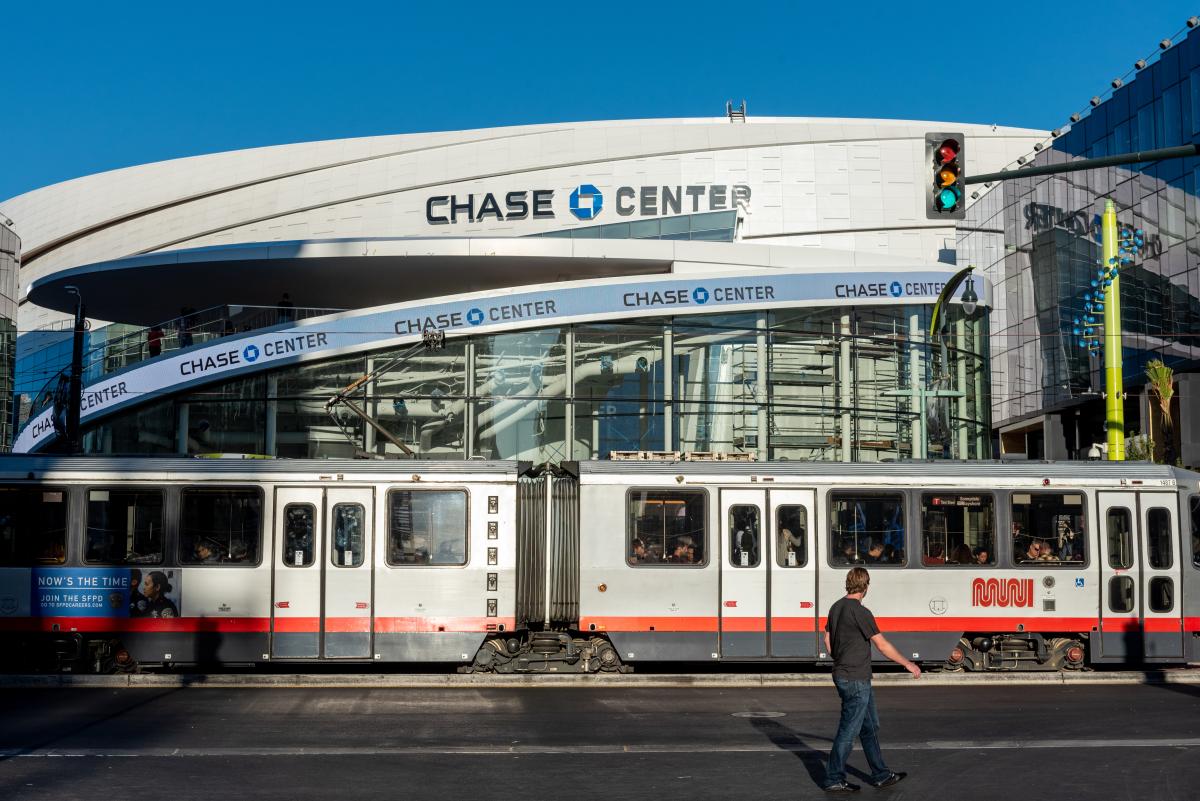
Photo of T Third in front of Chase CenterCalling all Warriors fans and Muni riders! As you know, an exciting preseason is underway, with the anticipated season opener scheduled to tip off in just a few weeks. As the Warriors look to a promising year with a committed staff and tenacious roster, it’s going to be an electrifying season for the six--time NBA Champs.

To catch these blue and (golden) yellow must-see games at 1 Warriors Way, consider taking Muni for free! Your game ticket (electronic or physical) is your all-day Muni ticket. The ticket provides quick and free Muni for bus and light rail lines (but not cable cars), up until the end of the service day at 2 a.m. after the event. Just show your ticket to the Station Agent or board through any door on our coaches. Muni uses all-door boarding across our system, so fans can board through any door and arrive quickly to the game! For the Muni Metro stations, if the booth is not occupied, proceed through the gate nearest the Station Agent window; the gate will open automatically. Here are additional guidelines for your fast, reliable and frequent trips.

This transit accommodation which aims to boost (affordable) ridership to Chase Center, is provided by the Transit Bundling Program. Sponsored by Mayor London Breed and the Golden State Warriors, Warriors ticket holders receive free service on Muni all-day on game day. But wait! There’s more!  Any ticket to a Chase Center event can also ride Muni all-day for free. It’s the same procedure and paid for by the Warriors. Thanks, Dub Nation!

The Warriors chose Mission Bay as the site for the new arena back in 2019 largely because of its transit-rich location with easy access to Muni and regional connections such as BART, Caltrain and Ferry services. Walking, biking or scooting are also additional modes of transportation.

As a reminder and to help stop the spread of COVID-19, federal law requires wearing a mask in Muni stations and while riding transit. Additionally, some Muni routes have been modified as a result of COVID-19 pandemic restrictions, the city’s emergency order and ongoing resource constraints. For details on Muni’s current routes and service, visit individual route webpages or the Muni Core Service Plan.   We’ll see you at Chase Center. Go Warriors! Go Muni!

Muni Service to Chase Center:

KT: K Ingleside-T Third Street - service to / from downtown San Francisco and Embarcadero BART Station. The stop is located on 3rd Street.

78X 16th Street Arena Express – service to / from 16th St Mission BART to Chase Center before and after the event. This shuttle stop is located on 3rd St near Illinois

22 Fillmore - serves as a connection to 16th St Mission BART. Exit 3rd St & Warriors Way. This stop is located on 3rd and Gene Friend Way.

15 Bayview Hunters Point Express - serves as a connection to Montgomery St BART. Exit 3rd St & Warriors Way.


Published October 04, 2021 at 11:04AM
https://ift.tt/3a7uiLD

Labels: ,

J Church Pilot Eases Subway Congestion for Muni Metro

J Church Pilot Eases Subway Congestion for Muni Metro
By Jonathan Streeter

In December 2020, the J Church returned as a surface-only route, much like its earliest predecessor, which opened in 1917.  Although the J Church travelled as far as the Embarcadero for more than 100 years, establishing Duboce Avenue as the terminal for this route as a test case was the result of careful analysis undertaken to improve the line’s poor reliability. This routing also allows us to address crowding and delays in the Muni Metro subway that plagued the system for decades.

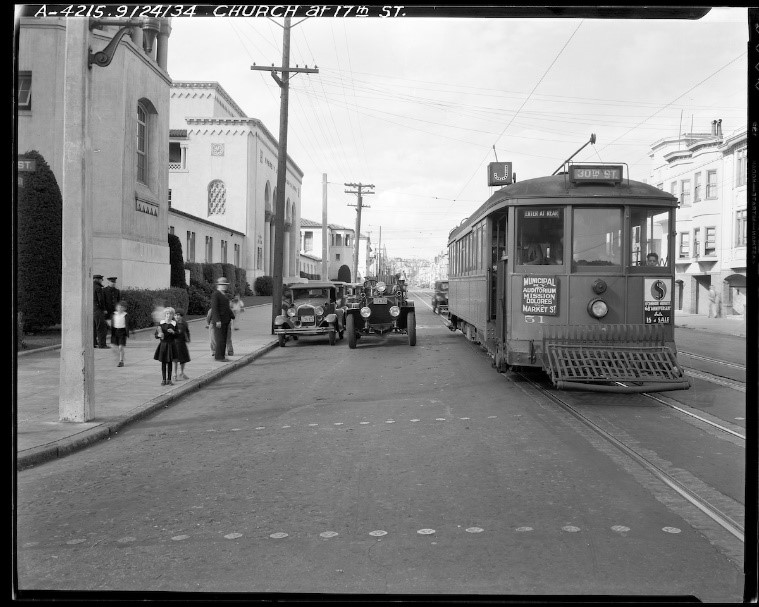
photo of the J Church near Dolores in 1926

The J Church in 1926

Surface Route

The J Church has historically had the lowest ridership of any Muni Metro line. Keeping it as a surface-only route should improve the J Church’s reliability and frequency, increase Muni Metro subway performance and reduce crowding. In addition, to enable the pilot we provided temporary accessibility and pedestrian safety upgrades at an intersection that is on the city’s High-Injury Network -- those San Francisco streets that have the highest severe and fatal collisions.

In addition to delays, there are other drawbacks to having the J Church Line in the subway. Once in the subway, the J’s lower-capacity one-car trains are unable to ease crowding at peak hours.  The shorter trains are necessary due to the limited length of platforms along portions of the surface route.  When the J line did go in the subway, those trains used the Embarcadero switch back to turn around, which limited its availability for other trains. Additionally, J Church (and N Judah) trains heading into the tunnel at Duboce Avenue must cross the path of all outbound subway traffic, which can cause system-wide delays.

Performance

When we surveyed J Church customers in 2019, 63% said the wait for a train was too long. Nearly four out of five people (78%) said they would walk farther to a stop for more reliable service or a shorter trip overall, including 52% of people with disabilities and 58% of seniors.  

Prior to the COVID-19 pandemic, poor reliability on the J Church meant that only about three out of four trains were showing up within five minutes of the expected time. Now, reliability has improved so that nearly nine out of 10 trains arrive without delay. Travel time on the J Church line’s surface route is less variable than the subway and didn’t change much during the pandemic. Avoiding subway congestion has eliminated the main source of unpredictable delays.

When transferring to the subway, customers at Church Station are seeing a high frequency of trains, minimizing the wait time for downtown destinations. At present the average wait time for an inbound train is two to three minutes. By comparison, the J Church frequently takes that amount of time simply to clear the Market Street intersection when heading northbound towards Duboce Avenue, and often took several minutes to enter the tunnel at Duboce.

Transfer Experience Improvements

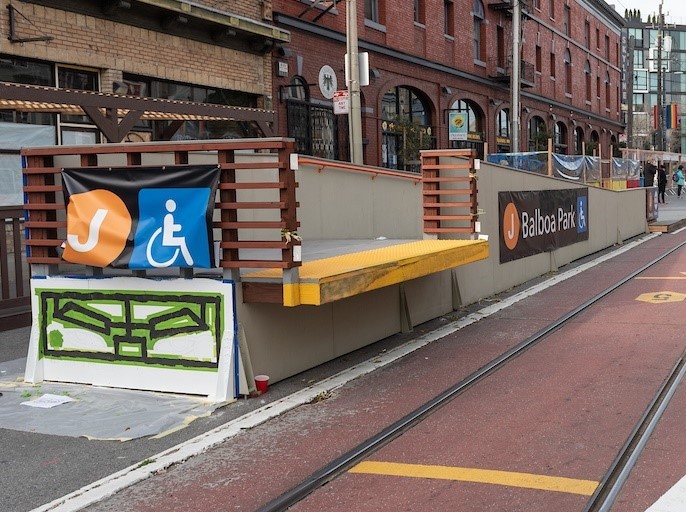
To support the shortened route, we installed temporary ramps in August 2020 that enable J Church customers with mobility limitations to access the Church Street Station elevator at Market Street or the N Judah accessible ramps at Duboce Avenue. We also installed a new temporary transit stop just south of Market Street to create a more seamless transfer to the subway. Learn more about these transfer improvements and proposals for additional upgrades at the J Church Transfer Improvements webpage.

Temporary accessible ramp on the 200 block of Church Street

Temporary accessible ramp on Church Street south of Market Street

Next Steps

This pilot project, fully operational since December 2020, will be reviewed by the SFMTA Board of Directors in December 2021 as a part of our overall 2022 Muni Service Network plan. If approved, the J Church shortened route would remain in place in 2022, but the line could still be returned to the subway in the future as our service plan continues to evolve.

To sign up for updates and provide feedback visit our J Church Surface Route webpage.


Published October 04, 2021 at 11:11AM
https://ift.tt/3oxIO84

Labels: ,

Friday, October 1, 2021

Essential Trip Card Program Provides Crucial Accommodations

Essential Trip Card Program Provides Crucial Accommodations
By Stephen Chun

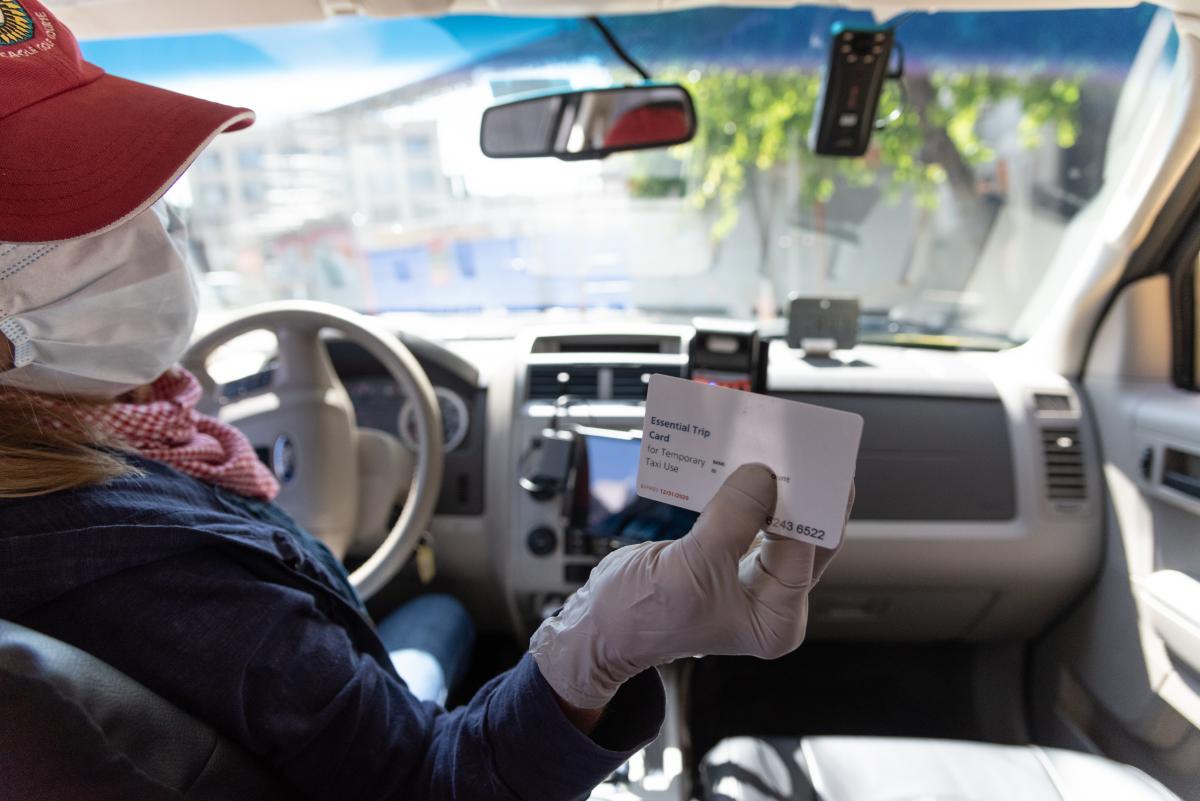
Photo of taxi driver holding essential trip card voucherDuring a time of unprecedented uncertainty, we reflect on a very successful 18 months since the launch of our Essential Trip Card (ETC) program.  The ETC is administered through the SFMTA’s Paratransit program (SF Paratransit) which has provided door to door van and taxi (paratransit) services for more than 40 years to people who are unable to independently use Muni, for some, all the time, because of a disability or disabling health condition.  
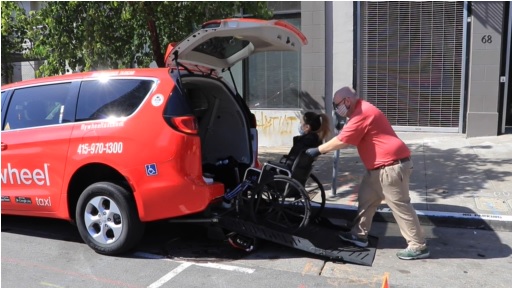
In response to the Muni service reductions in April 2020, the ETC program was launched to provide seniors and persons with disabilities with safe and door-to-door taxi service to essential services during the pandemic as a supplement to the existing Muni service. Such essential trips include grocery shopping, pharmacy visits, medical treatments, and later, vaccination appointments.

Once enrolled, ETC participants receive a monthly taxi subsidy of $60 (for a $12 cost) to pay for taxi rides, similar to a regular card payment for a taxi. This allows participants to take approximately four to five one-way trips each month via taxi while receiving an 80% discount.

In an effort to continue providing discounted taxi services and prioritizing access to vaccinations for its participants, the SFMTA issued a one-time allotment increase of $60 (for an additional $12 cost) in February 2021, when vaccines started becoming widely available. This provision avoided participants dipping into their existing monthly trip budget while being able to use a taxi services to get to and from their vaccination appointments. And while an ETC participant is limited to a $60 monthly subsidy, those with extenuating circumstances who may have greater transportation needs can request a permanent increase of their monthly taxi allotment to $120, or rather another $60 allotment increase (for a $12 cost).

The ETC has been a critical and previously mentioned, a successful program for those seniors and riders with disabilities. Even as SFMTA provides additional service to ensure that 98% of residents live or work within two blocks of a Muni stop, the ETC program remains a lifeline for important trips that are difficult for seniors and persons with disabilities to make on Muni.  Furthermore, as trip numbers were higher after the vaccination availability than from before, this program has instilled greater self confidence for seniors and persons with disabilities to make essential trips as such and provides a safety net for greater mobility and engagement as they resume their normal activities.

Since its inception, approximately 4,400 seniors and persons with disabilities have enrolled in the program and over 86,000 trips have been performed.  A strong partnership between SFMTA, SF Paratransit and the taxi industry, executing successful community-based outreach and incorporating public feedback, including those from the Paratransit Coordinating Council, were all key components in implementing the program so quickly and with such success!

SF Paratransit and ETC intends to roll the program into FY21-22 and is committed to continuing to provide safe, reliable and discounted taxi service trips for seniors and people with disabilities. For eligibility, registration and FAQ’s, please visit the Essential Trip Card webpage.

As an added note, SF Paratransit for those with disabilities who are eligible under the Americans with Disabilities Act (ADA) is provided throughout San Francisco, including Treasure Island, to the northernmost part of Daly City in San Mateo County and to the Marin Headlands on weekends. Also, once ADA-certified to use paratransit, a participant may also be eligible to receive ADA paratransit services in other cities and states. Please visit our SF Paratransit Eligibility and Registration page for more information.

Photo of taxi driver assisting wheelchair user enter into the vehicle


Published October 01, 2021 at 11:41AM
https://ift.tt/3uxd43L

Labels: ,

Wednesday, September 22, 2021

Improving Safety and Access to Golden Gate Park

Improving Safety and Access to Golden Gate Park
By Chava Kronenberg

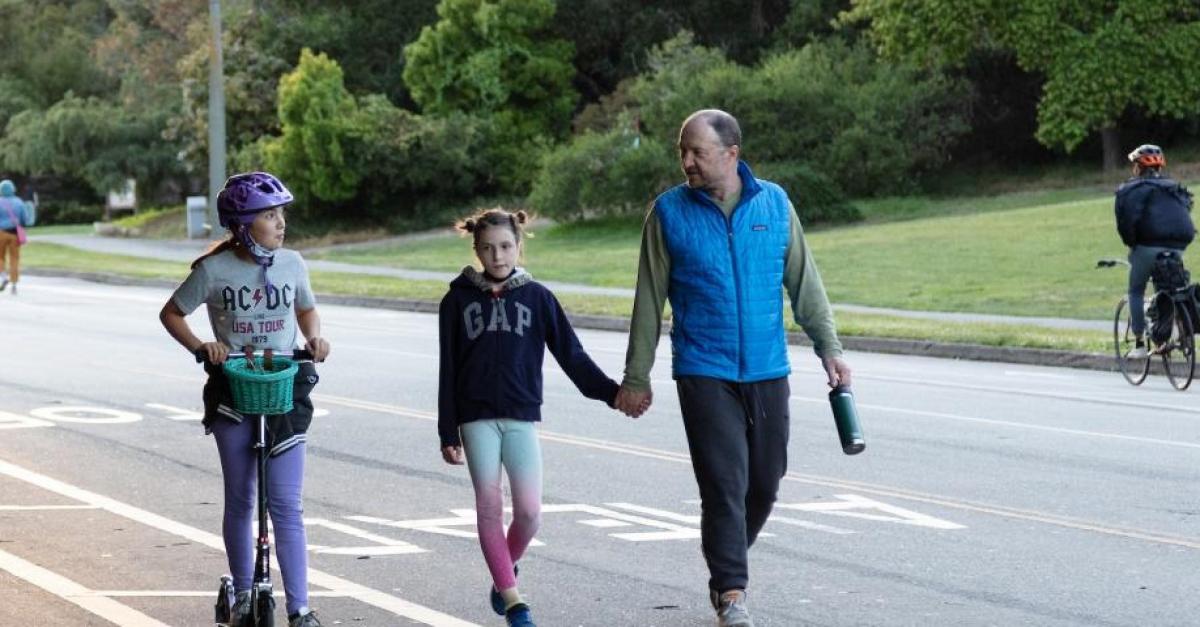
Photo of girl on scooter, man holding child's hand walking, and a person on a bicycle in Golden Gate ParkToday, the San Francisco Recreation and Park Department (RPD) and the SFMTA are jointly launching the Golden Gate Park Access and Safety Program, an effort to consider a post-pandemic set of closed or restricted access streets and mobility choices in San Francisco’s most iconic park.
During the first weeks of the pandemic, RPD closed JFK Drive on the east side of the park to drivers, following up with additional segments on the west side including Middle Drive and MLK. Closing these streets in 2020 was a step in decades of reducing the number of streets for cars in the park, and furthered a long conversation about opening JFK Drive to people walking, biking, scooting, rolling, dancing, and skating.

We’ve been monitoring and learning from the current car-free streets in the park. Since the closure, we’ve seen almost 7 million walking, biking, and rolling trips on JFK Drive, representing a 36% increase in people visiting the Park on the car-free route (compared to pre-pandemic visits).  With the elimination of cut-through traffic there have been no serious injury collisions on the car-free route (there were more than 50 such collisions over the 5 years prior). We have also seen faster transit service on the 44 O’Shaughnessy Muni line, which travels through the Music Concourse and serves the Bayview & Excelsior neighborhoods.

However, in addition to these successes, there have been access challenges for popular destinations and for park visitors in the disability community. The purpose of the Golden Gate Park Access and Safety Program is to bring a broad array of project proposals that can make access to the park even better than before the COVID closure while still retaining the traffic safety and park experience improvements we’ve experienced.

So now we’re ready to ask you:

  • Which streets should be closed to cars post-pandemic in Golden Gate Park?
  • What new or improved mobility options can be implemented to make these closures work for everyone?

Today, we’re launching our public outreach process through the GGP Access and Safety Online Open House, and with scheduled virtual information sessions and in-park tours. The proposals include potential street closures within Golden Gate Park, improved access to mobility services like the park shuttle, taxis, bikeshare, scootershare, pedicabs and more.

The upcoming public events include:

You can also contact us at GGPAccess@sfmta.com if you’d like a presentation for your organization, or to give us direct feedback. More information about how to engage in the program and the overall effort is on our webpage. We look forward to working with you to make Golden Gate Park safe and accessible for everyone.


Published September 22, 2021 at 09:19AM
https://ift.tt/39tQhfC

Labels: ,

Friday, September 17, 2021

SFMTA Resumes Peak Hour Tow-Away Zone Enforcement

SFMTA Resumes Peak Hour Tow-Away Zone Enforcement
By Jessie Liang

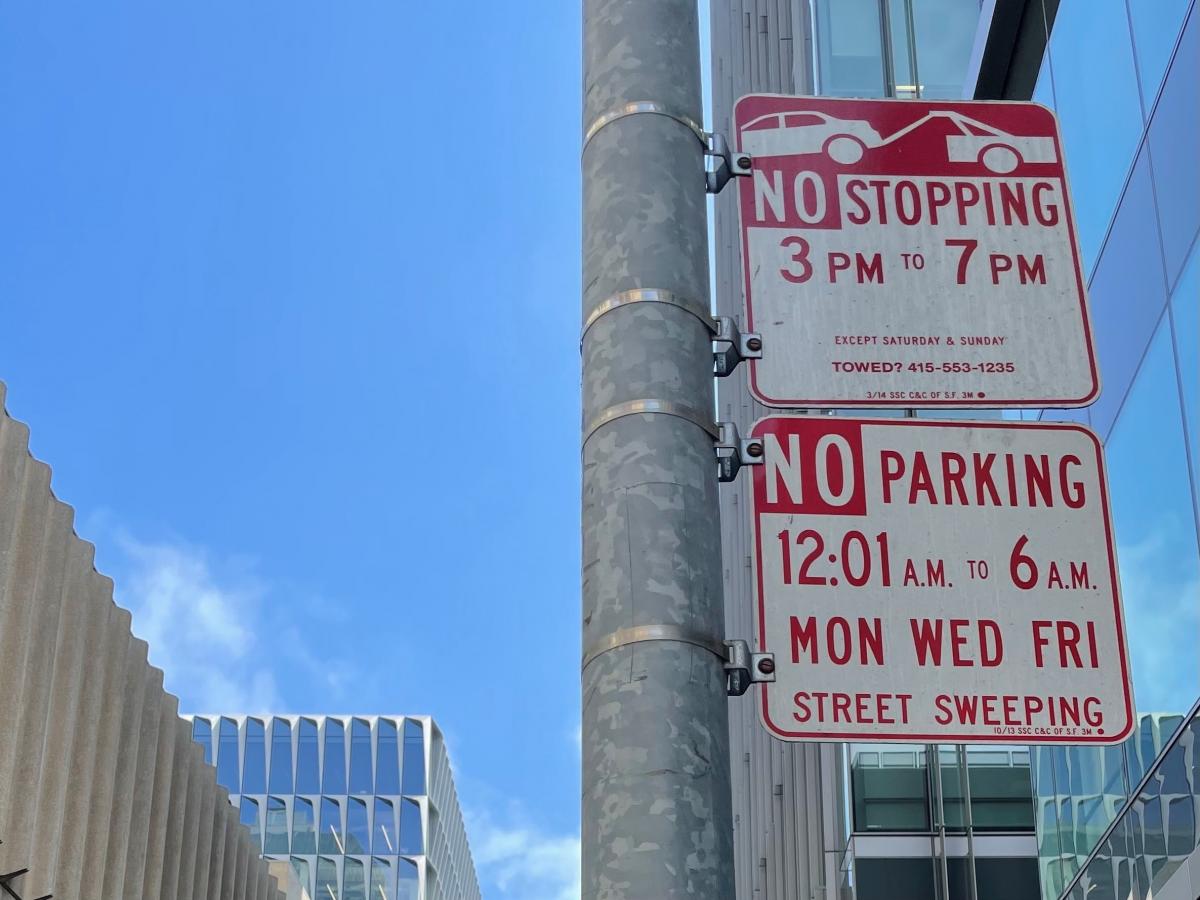
sign showing no stopping 3-7 pm

The SFMTA’s towing programs were temporarily suspended in March 2020 in response to the COVID-19 pandemic. As the city has reopened and traffic has returned, the SFMTA will resume enforcement of peak hour commuter tow-away zones starting September 20.

Vehicles parked at tow-away zones during restricted peak hours will be subject to citation and towing. 

We’re bringing back the enforcement of peak hour tow-away zones under the SFMTA Transportation Recovery Plan (TRP) as the economy reopens. Tows help the SFMTA facilitate the flow and safety of transit and traffic, support economic activity and maintain safe streets.

The reinstated tow-away enforcement will accommodate changing conditions on city streets. For example, enforcement will not apply to Shared Spaces that allow merchants to use sidewalks, full or partial streets and other nearby outdoor spaces under San Francisco’s Public Health Orders.

In addition to tows at peak hour tow-away zones, towing for all other violations will continue. These include but are not limited to, tows for violations of 72-hour overtime parking limits, vehicles with expired registrations over six months and vehicles with five or more delinquent parking citations.


For more information, please visit the Parking and Driving section of SFMTA’s COVID-19 Developments & Response.


Published September 17, 2021 at 07:34AM
https://ift.tt/39ft0Ow

Labels: ,